Solutions · Universities & teaching hospitals
Your students are already asking AI. The question is what it teaches them.
They're putting cases to generic chatbots tonight, sanctioned or not, and learning to trust fluent, unsourced, sometimes fabricated answers. That's the wrong habit at exactly the formative moment. viggoVet's evidence tools, VetEvince and the AI Drug Formulary (coming soon), cite the published research behind every answer, so the habit students build is the one the profession depends on: read the source, weigh the evidence, then decide. The AI shows its work; the student learns to check it.
AI Anesthesia Assist and AI Dental Chart for teaching-hospital caseloads.

Decision support as a teaching instrument.
The hardest skill in the degree is the move from "what's the answer" to "what's the evidence, and how good is it." Cited AI makes that move visible. When VetEvince (coming soon) returns ranked differentials, each carries a live citation a student can open, read, and challenge, under faculty supervision, with the clinician holding every decision. The AI's reasoning becomes the seminar material: where does the evidence hold, where is it thin, and what would change your mind?
For students, exam help is coming to VetEvince: a study companion that reasons across the syllabus the way the exams demand, and shows its sources while it does. The AI Drug Formulary brings the same traceability to pharmacology: 1,300+ medications, 11,000+ dosages, across the 80+ species a teaching caseload actually spans.
Free in every plan when it launches, under our fair-usage policy, sized for busy, back-to-back daily practice.
On rotations.
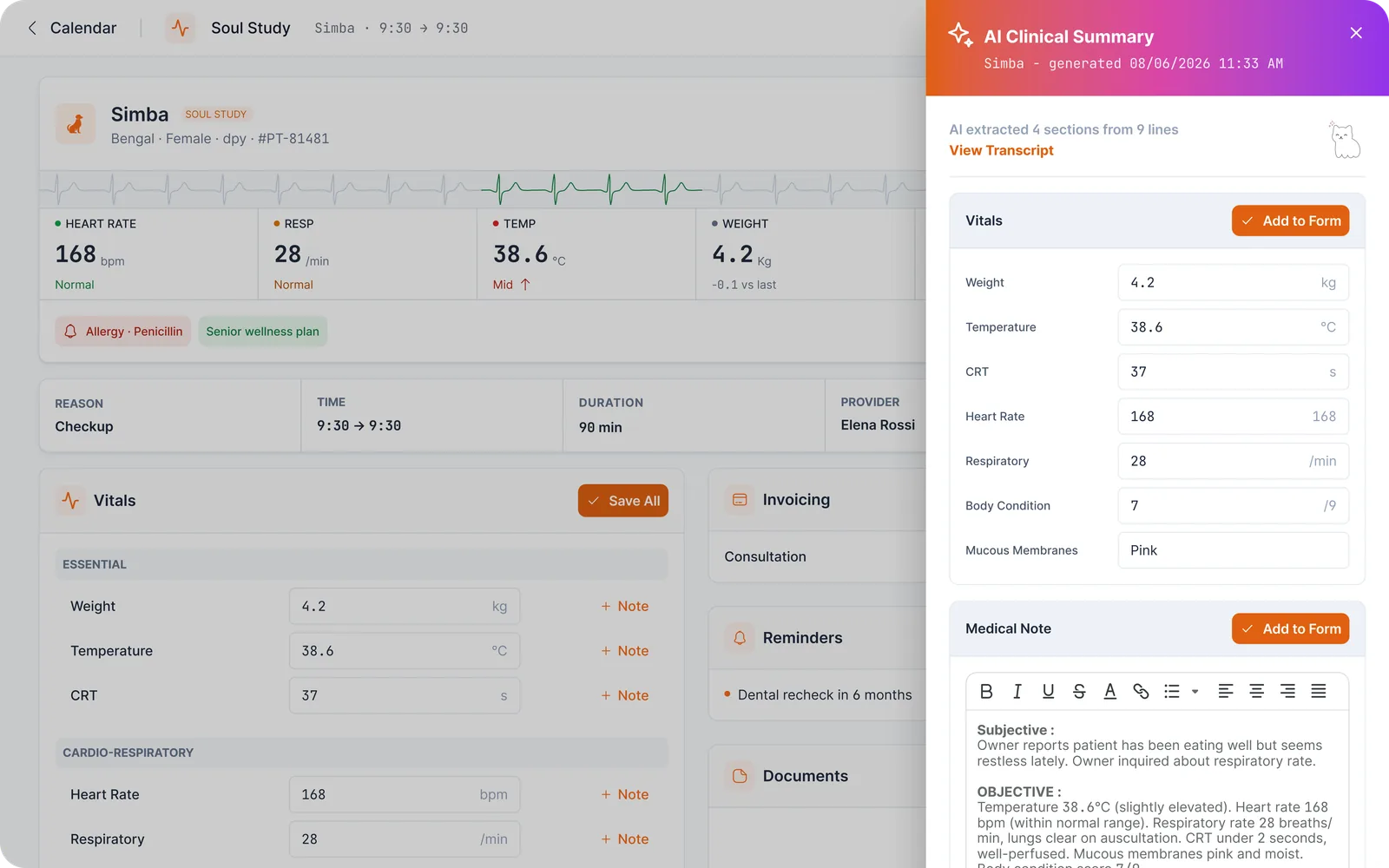
AI Anesthesia Assist
On anesthesia rotations, each vitals entry returns a stability or risk indication with a guideline-based comment in 10 to 30 seconds, surfaced for the supervising clinician's review, and a structured talking point for the students at the table: here's what the guidelines flag on this patient; what do you see? Advisory decision-support with manual vitals entry, stated plainly, the clinician decides, which is itself the lesson.
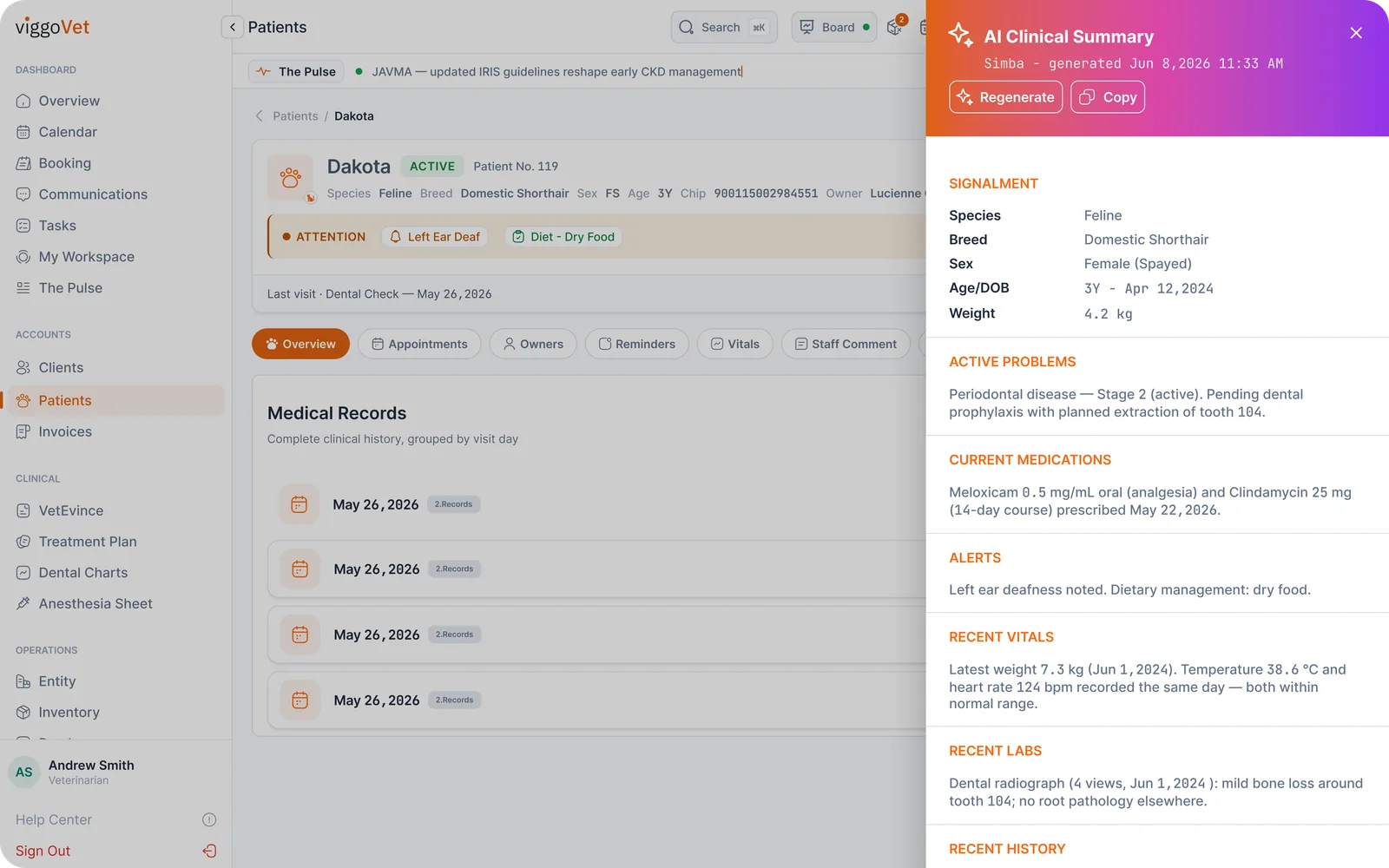
AI Dental Chart
On dentistry rotations, students see the full arc from charting to communication: findings, grading, prognosis, SOAP, and the plain-language client letter that shows how specialist findings become an owner's informed consent.
viggoVet's AI is clinical decision-support only. It assists; it does not decide. The licensed veterinarian holds full clinical responsibility. It is not a medical device, monitor, or alarm.
Teach them to ask what the model scores.
Fits the institution, not just the curriculum.
Alongside your systems.
viggoVet works alongside the established record and management systems a teaching hospital already runs, no migration to begin, no upheaval in a hospital that can't pause.
Every species, every cohort.
All-species across 80+ species, from the equine ward to the exotics service, and 28+ interface languages for international cohorts and visiting clinicians.
Evidence you can audit.
Built since 2021 with 300+ contributing vets, every answer cited to published research. Faculty can trace any output to its source, which is precisely what makes it teachable.
Part of the viggoVet platform.
Every tool on this page is one module of viggoVet, the open veterinary platform. The platform completes any practice software with the clinical AI it's missing, hosts the tools other veterinary companies build on it through its marketplace, and can run a whole practice end to end for clinics that choose it. Start with the module that solves today's problem; the platform is there as you grow.
Common questions
How is this different from students using a general-purpose chatbot?
Every answer from VetEvince and the AI Drug Formulary is cited to published veterinary research the student can open and verify. Instead of training students to accept fluent, unsourced output, it trains them to follow the citation to the study and judge the evidence, the reasoning their examiners and their future patients require.
Is it safe to put AI in front of students?
It's decision-support, used under supervision, it assists; it does not decide. The supervising clinician holds full clinical responsibility, and students see that hierarchy modeled in the tool itself: every output is an input to a human decision, never a substitute for one.
Will it help with NAVLE- and RCVS-style exam preparation?
Yes, exam help is coming in VetEvince, which has not launched yet. As a study companion it will reason across the breadth the syllabus covers, and because each conclusion is cited, students practice tracing reasoning to evidence, the skill the exams reward.
What does it cost a university?
VetEvince and the AI Drug Formulary will be free at launch under our fair-usage policy, for students and clinicians alike. The clinical-floor tools, AI Anesthesia Assist and AI Dental Chart, start from $49 per clinic per month. For institution-wide arrangements, get in touch and we will shape it to your hospital.
Will it interfere with the hospital's existing record systems?
No. viggoVet works alongside the systems your teaching hospital already runs. There is no migration required to begin, and adoption can start with a single rotation.
The next generation of vets will use AI. Teach them to demand citations.
Talk to us about your teaching hospital, rotations, cohorts, and a rollout that fits the academic year.