Solutions · Emergency & critical care
The 2am patient comes with no history. Bring a second perspective.
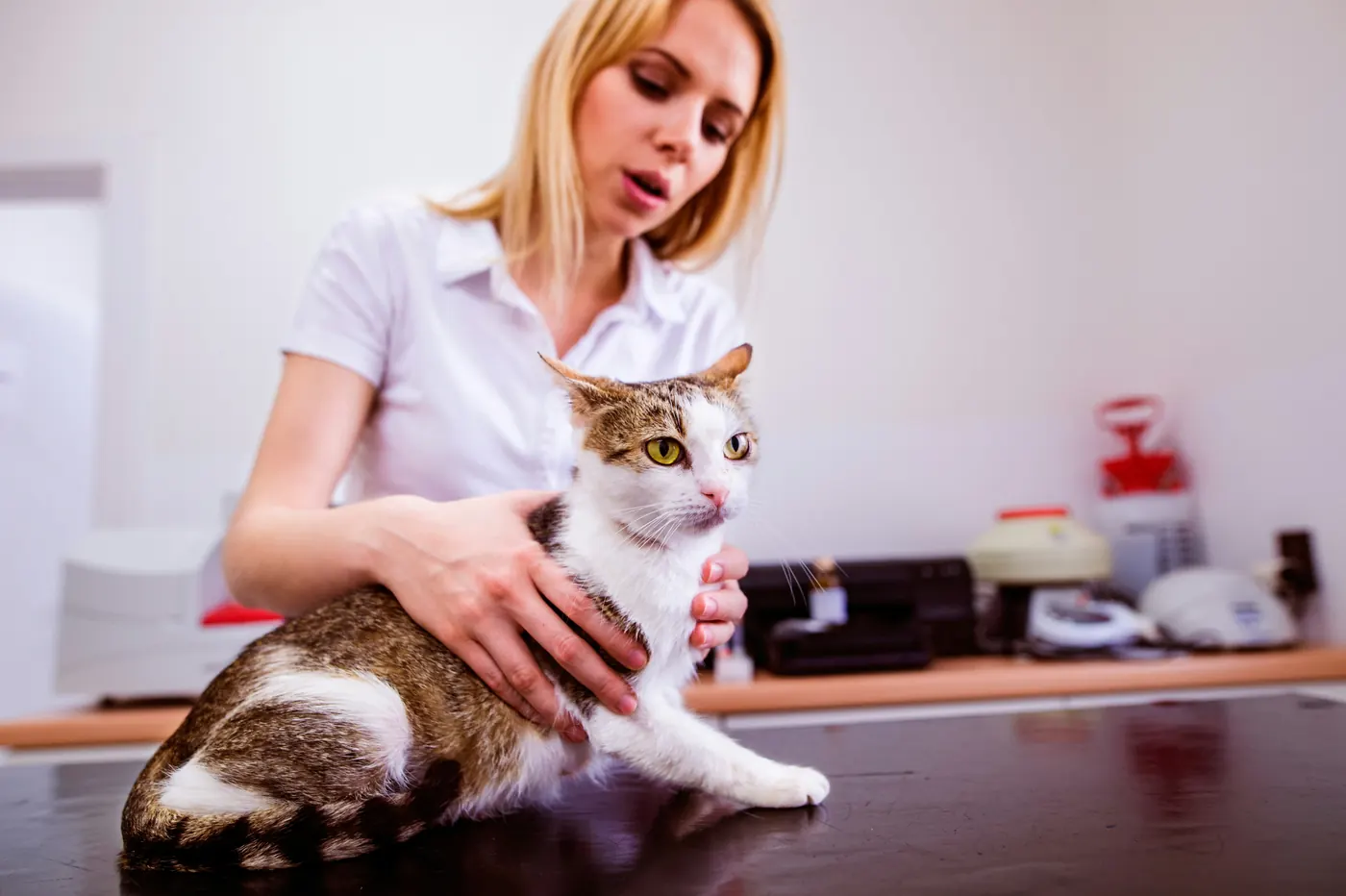
A hit-by-car at 2am, no records, an owner who can't remember the medication name, and a patient who may need anesthesia sooner than you would like, with very little margin. Emergency medicine is high-stakes decisions with fewer colleagues to bounce them off. viggoVet doesn't make those decisions, and never will. It reads whatever you have entered, signalment, weight, the drugs already given, and puts guideline-based considerations in front of you at the speed the case demands, and leaves the call where it belongs: with you.
AI Dental Chart is in every plan, from $49 per clinic per month; AI Anesthesia Assist is on Elite, $79 with 20 users. Works alongside whatever your ER already runs.
viggoVet's AI is clinical decision-support only. It assists; it does not decide. The licensed veterinarian holds full clinical responsibility. It is not a medical device, monitor, or alarm.
Anesthetic support for the patient least able to tolerate it.
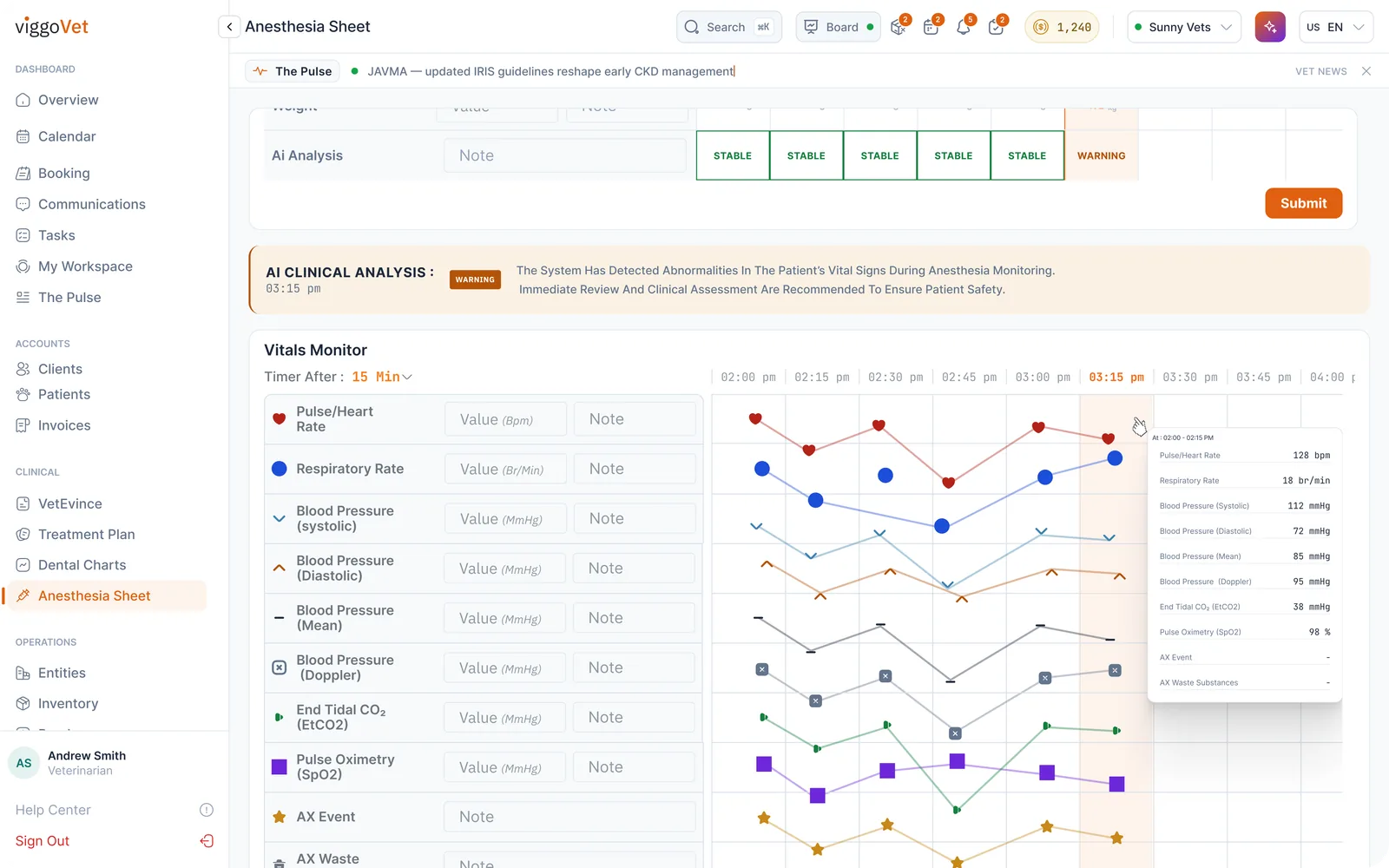
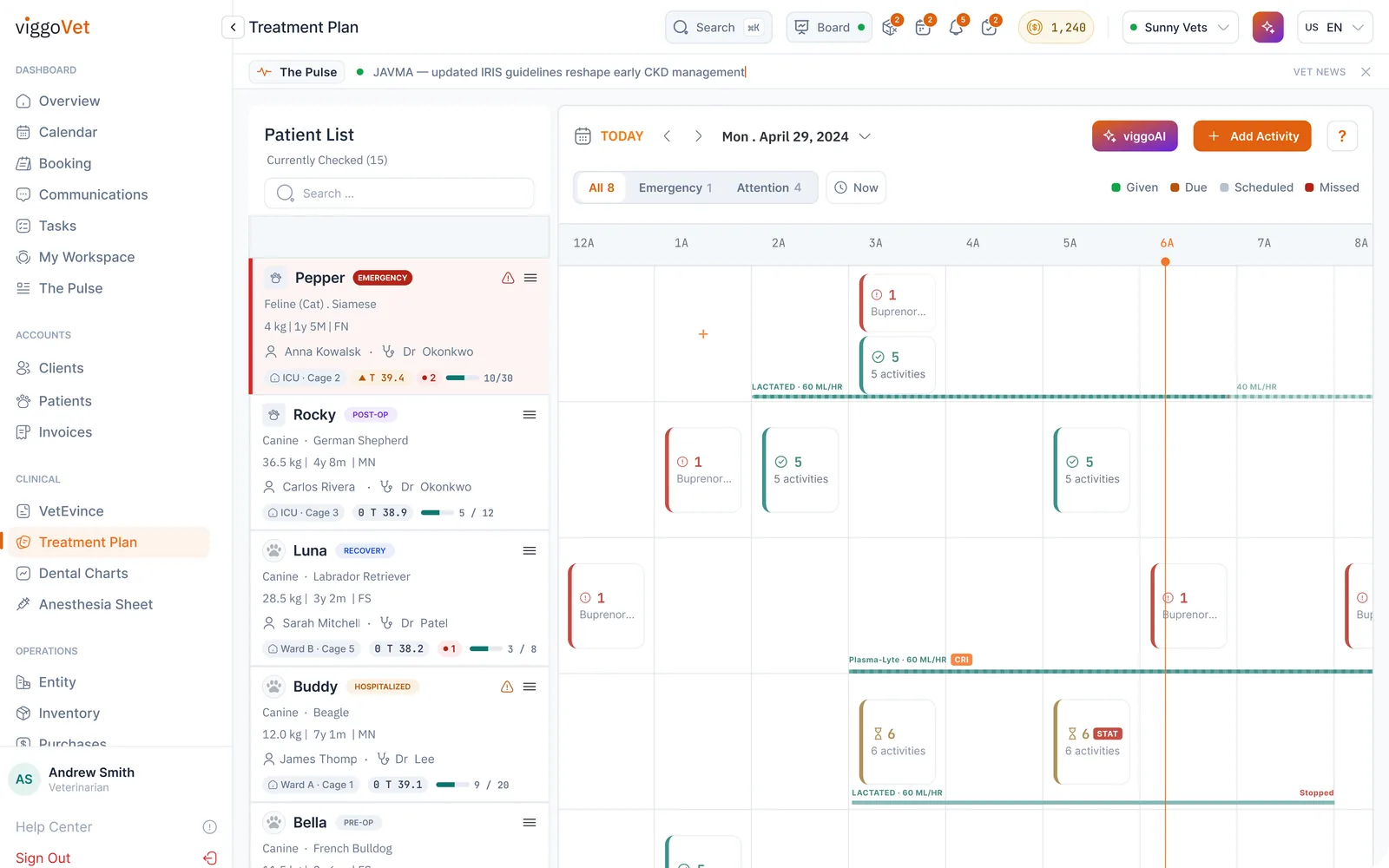
In the ER, the patients heading to anesthesia are often the ones with the narrowest margins. AI Anesthesia Assist is advisory decision-support for exactly those cases: at each vitals entry your team makes, it reads the numbers against everything known about the patient and surfaces a stability or risk indication, stable, unstable, risk, or emergency, with a guideline-based comment, in 10 to 30 seconds. It surfaces indications and patient-specific considerations for your review and interpretation; recognizing and responding to the emergency remains entirely the veterinarian's work.
When a patient is trending the wrong way, it surfaces options to consider, you weigh them, you decide. And because documentation is the first casualty of a fast-moving case, the anesthesia record, aftercare instructions, and owner discharge notes are drafted as you go, so the record keeps pace with the patient.
Vitals are entered manually today, stated plainly, because an ER deserves to know exactly what a tool does and doesn't do.
The fractured tooth that walks in at midnight.
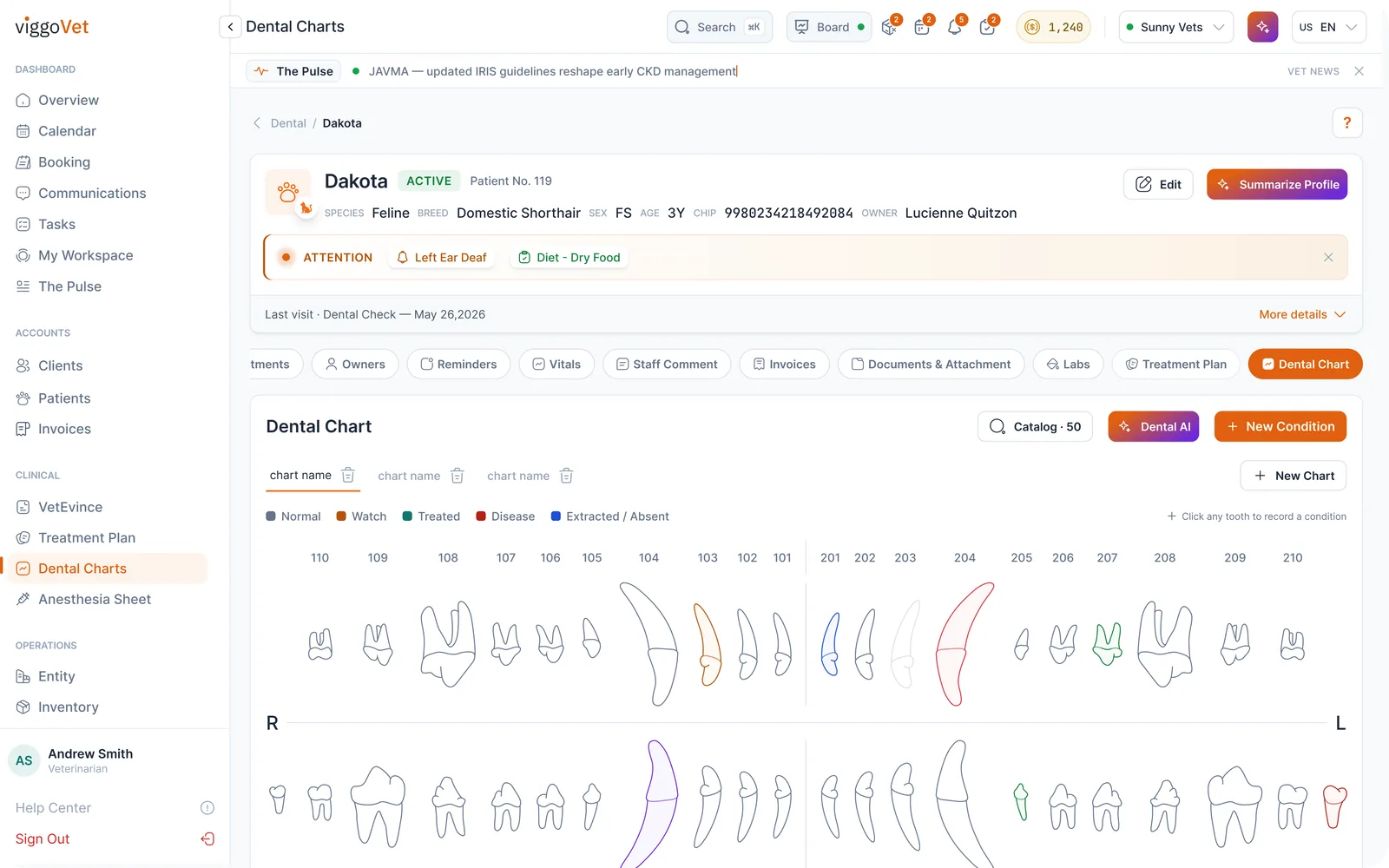
Not every emergency is a trauma. For the dental emergency on an overnight shift, pain control comes first; then AI Dental Chart lets you chart what you found and hand the day team a clear record, with a plain-language letter for an owner making a stressed decision at a bad hour. If it goes to theatre, the anesthesia sheet opens straight from the procedure.
Fast evidence for unfamiliar presentations.
The toxin you've never dosed an antidote for. The presentation you've read about once. Two tools are coming for the moments when the reference shelf is too slow:
VetEvince
Free at launch, describe the presentation, get ranked differentials, diagnostic pathways, and treatment options, each cited to published veterinary research you can verify mid-case. The colleague who has read the emergency literature and is awake at 2am, for your review, never instead of it.
AI Drug Formulary
Free at launch, 1,300+ medications, 8,000+ interactions, 11,000+ dosages across 80+ species. Antidote dosing and emergency-drug combinations confirmed against the evidence instead of recalled from memory at hour eleven of a shift.
Free in every plan when it launches, under our fair-usage policy, sized for busy, back-to-back daily practice.
No migrations in the middle of the night.
An emergency hospital is no place to be mid-software-change. viggoVet's tools work alongside whatever your ER already runs, your practice software, labs, and communication tools stay exactly as they are. Add one tool, prove it on the floor, and go from there. If your hospital ever wants everything on the full viggoVet platform, that's a daylight decision for another day.
Free trial, full features, cancel anytime during the trial at no charge · then from $49 per clinic per month (Professional, 5 users), or $79 with AI Anesthesia Assist (Elite, 20 users). See transparent pricing →
Part of the viggoVet platform.
Every tool on this page is one module of viggoVet, the open veterinary platform. The platform completes any practice software with the clinical AI it's missing, hosts the tools other veterinary companies build on it through its marketplace, and can run a whole practice end to end for clinics that choose it. Start with the module that solves today's problem; the platform is there as you grow.
Common questions
Is AI Anesthesia Assist a monitor or an alarm?
No. It is advisory decision-support only. At each manual vitals entry it surfaces a stability or risk indication with a guideline-based comment for the veterinarian to review and interpret. It is not a medical device, monitor, or alarm, and it does not detect or respond to anything on its own, the veterinarian holds full clinical responsibility at all times.
Can it handle an emergency for us?
No, and we won't pretend otherwise. It surfaces indications and patient-specific considerations for the vet's review; recognizing, deciding, and acting are the veterinarian's work. Think of it as a fast, well-read second perspective, never a second pair of hands.
How fast is it in practice?
Each vitals entry returns a stability or risk indication with a guideline-based comment in 10 to 30 seconds. The documentation, anesthesia record, aftercare, discharge notes, drafts itself alongside the case.
What does it cost an emergency practice?
AI Anesthesia Assist is on Elite, $79 per clinic per month with 20 users, all of whom can be vets, so the rotating roster costs no more per head; AI Dental Chart is in every plan from $49. Every plan starts with a free trial, cancel anytime during it at no charge.
Will it interfere with the hospital software we run now?
No. The tools work alongside your existing practice software, labs, and communication systems. There's nothing to migrate and nothing to switch, which matters in a building that never closes.
The next unstable patient won't wait for morning.
Run AI Anesthesia Assist on your floor, free, advisory support at every vitals entry, alongside everything your ER already runs.