Advisory decision-support
AI Anesthesia Assist
As your team logs routine vitals during a procedure, the AI reads each entry against the patient's full profile, breed, age, weight, pre-existing conditions, current medications, anesthetic protocol, and surfaces a stability or risk indication with a guideline-based comment, in 10 to 30 seconds. Patient-specific considerations, flagged for your review. You weigh them. You decide.
Every vitals entry, read against your patient's complete history, and returned as an indicative assessment you interpret.
Free trial · then on Elite, $79 per clinic per month with 20 users. Works alongside whatever your clinic already runs.
viggoVet's AI is clinical decision-support only. It assists; it does not decide. The licensed veterinarian holds full clinical responsibility. It is not a medical device, monitor, or alarm.
No vet should carry a long anesthesia alone.
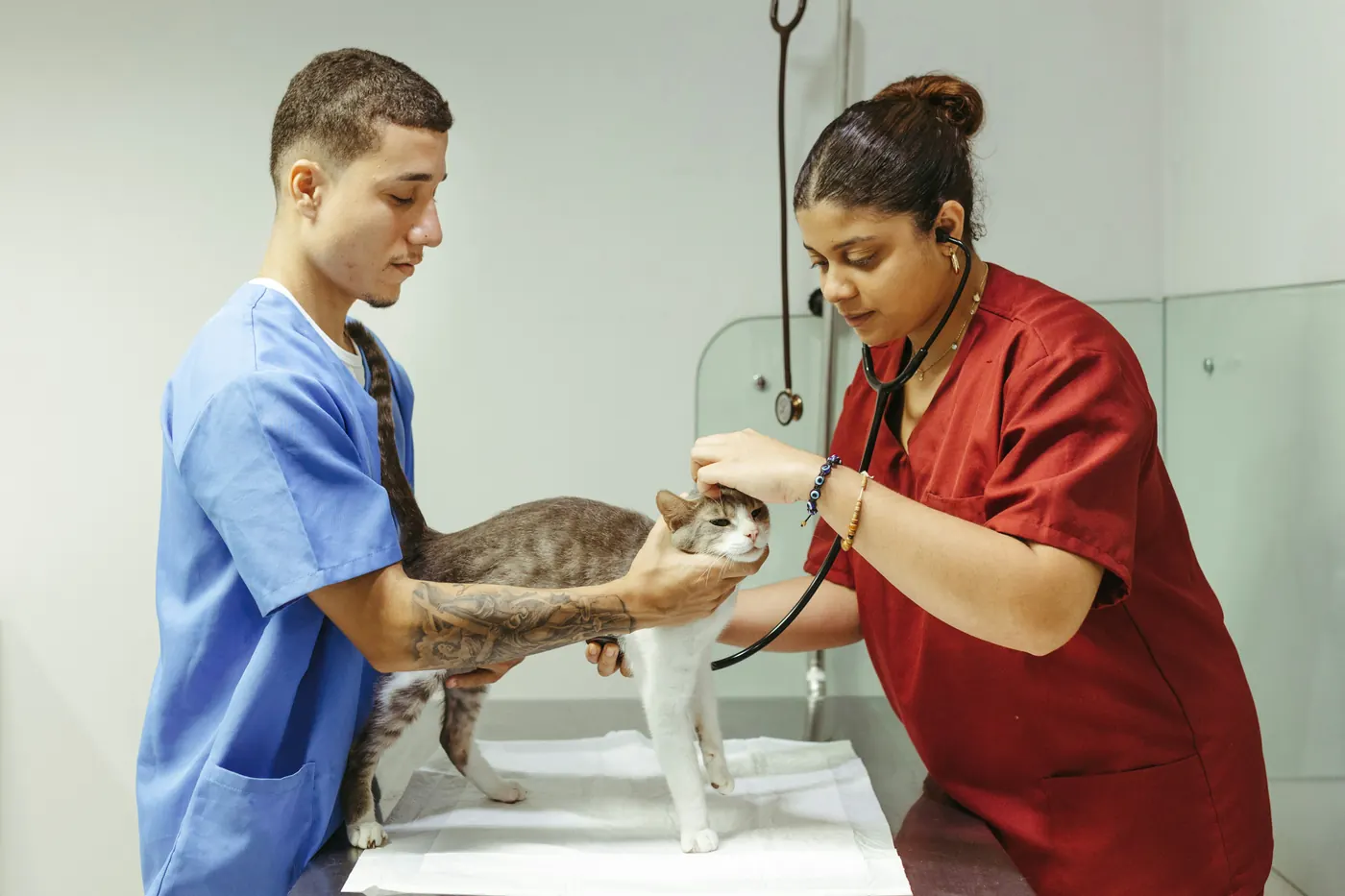
A nine-year-old spaniel, a grade II murmur in the history, ninety minutes into a dental under GA. The numbers your tech just logged look acceptable on their own, but acceptable for this dog, on this protocol, at this stage? That's the question that sits on your shoulders while the next case waits.
Just Viggo it.
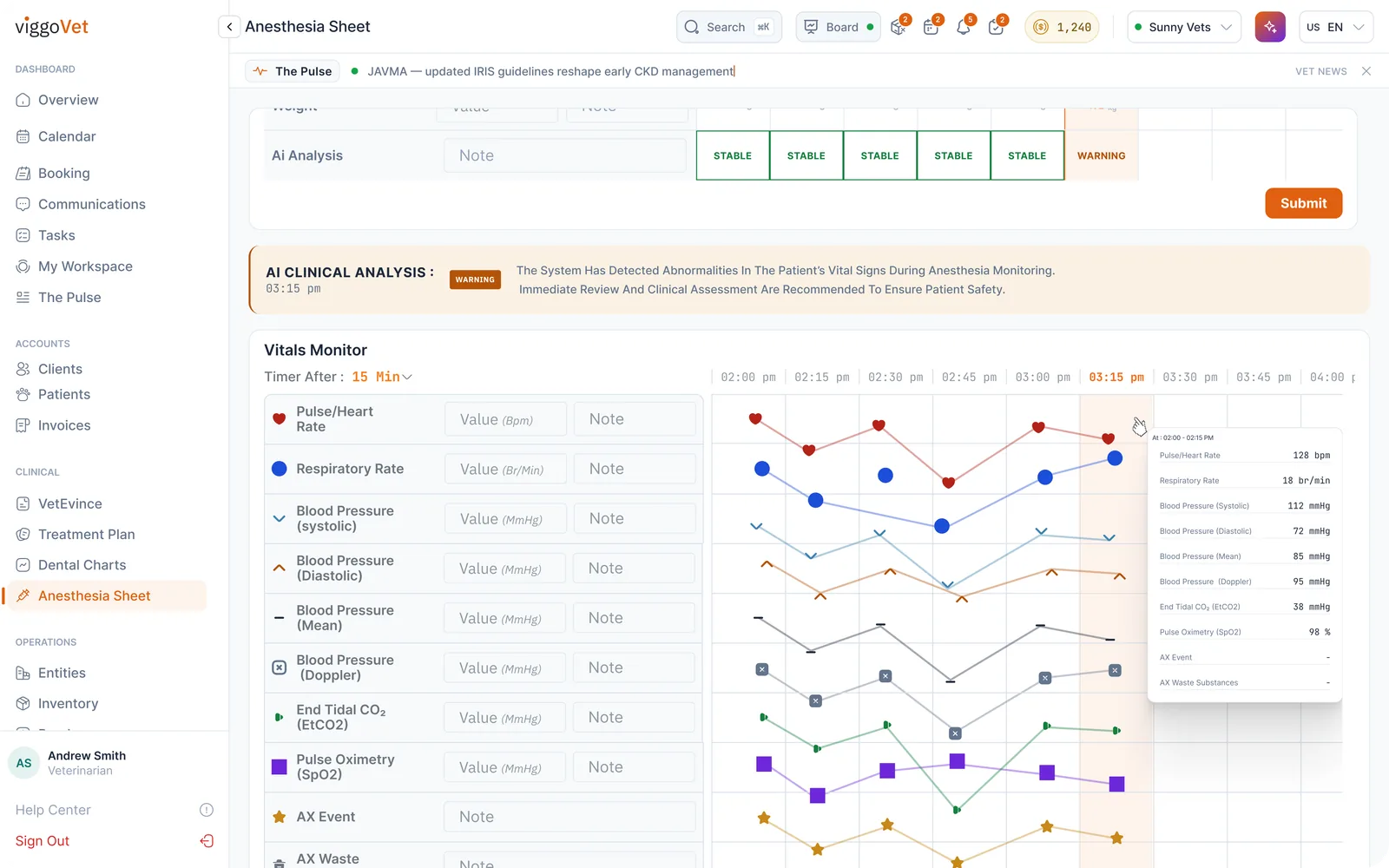
At that entry, and every entry, AI Anesthesia Assist reads the numbers against the patient's complete history and surfaces a stability or risk indication with a guideline-based comment, in 10 to 30 seconds. A heart rate of 60 bpm means something very different in a Labrador than in a Chihuahua; the comment tells you which case you're in, and cites the guideline it leans on.
It's not a replacement for your clinical judgment. It's a second perspective on every entry, one that has read the patient's whole file and the published guidelines, and puts both in front of you.
Four steps. Advisory at every entry.
- 01
Log the vitals you already take.
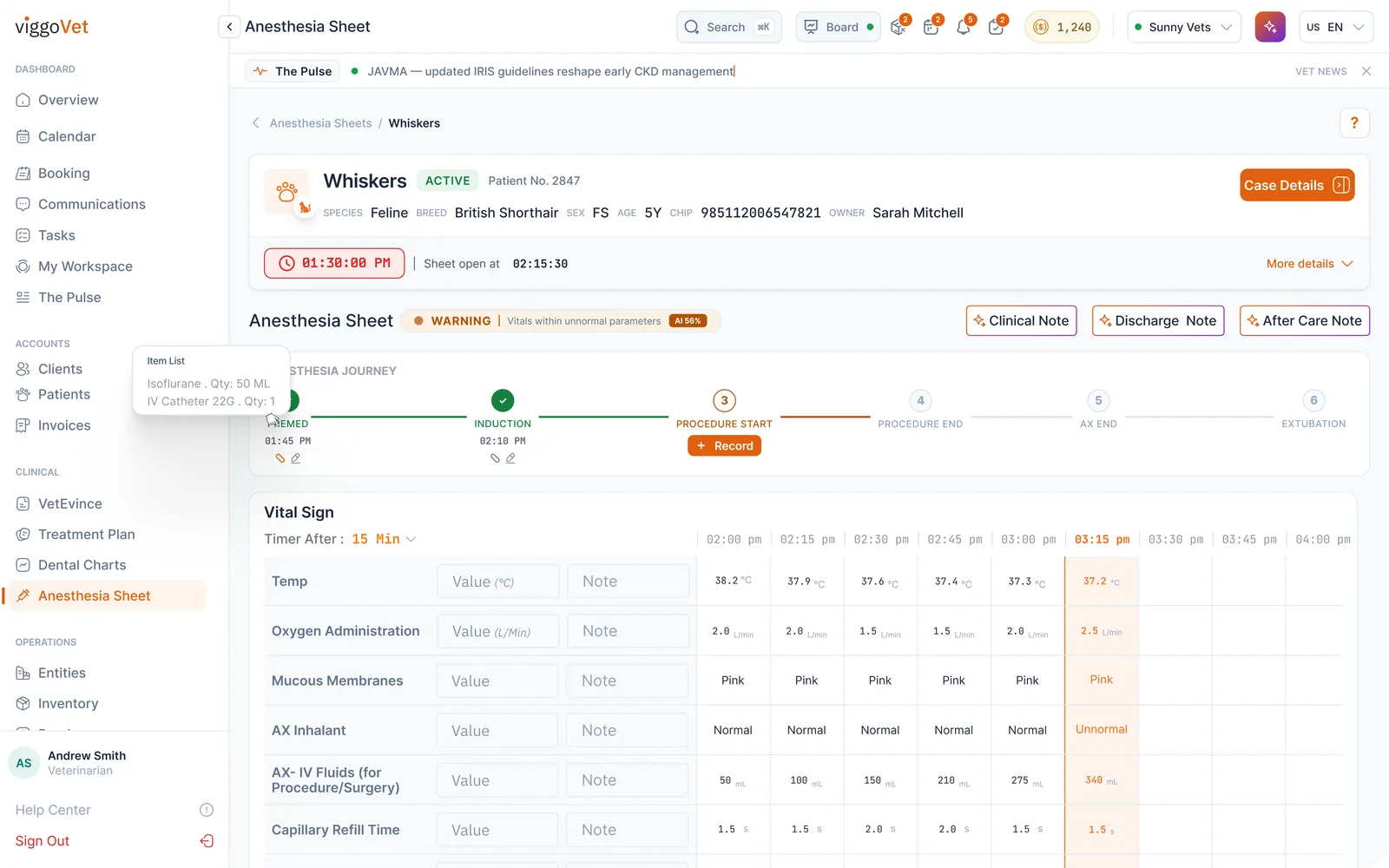
As part of the routine vitals checks your team already does, enter heart rate, respiratory rate, SpO2, blood pressure, temperature, ETCO2, and anesthetic depth. The entry form is built for gloved hands and OR conditions, so an entry takes seconds.
- 02
The AI reads the entry against the whole patient.
Each entry is analyzed against this patient's breed, age, weight, pre-existing conditions, current medications, and anesthetic protocol, not against a generic reference range.
- 03
You get a stability or risk indication, with the reasoning.
A per-entry indication, stable, unstable, risk, or emergency, with a guideline-based comment explaining why, typically in 10 to 30 seconds. An indicative assessment you interpret, not a verdict.
- 04
When an entry points to trouble, considerations are surfaced for your review.
The AI surfaces patient-specific options for you to consider, a possible drug, an example dose worked for this patient's weight, the route, and the rationale, drawn from published veterinary anesthesia emergency guidelines, with sources cited. Suggestions you review and decide on, never an action the AI takes on its own.
What you get.
Per-entry stability indication.
At each vitals entry, an indication of the patient’s anesthetic stability with a guideline-based comment, not "is this number in range," but "is this number right for this patient at this stage of the procedure." You interpret it; it doesn’t decide for you.
Patient-specific considerations when it matters.
If an entry points to a problem, the AI flags it for your review and surfaces options to consider, possible drug, example dose for this patient’s weight, route, rationale, each with the published evidence behind it. You stay in command throughout.
Complete anesthetic record.
Generated from the entries you logged: every value, every trend, every intervention, formatted for your medical records. The documentation writes itself while you work.
Aftercare protocols.
Patient-specific post-anesthetic care instructions for your team, recovery parameters to follow, pain-management protocols, and what to look for in the first 24 hours, based on the procedure, the patient’s conditions, and the protocol used.
Discharge notes and client letters.
Clear, owner-friendly instructions, what happened, what to expect at home, medication schedules, and when to call. Specific to this procedure and this patient.
A note about hardware, stated plainly.
Today, vitals are entered manually into AI Anesthesia Assist. We know that adds a step, and we'd rather tell you that plainly than imply otherwise. Device integration is on our roadmap, when it's ready, vitals will flow in automatically. In the meantime, most teams find the tech handling the anesthesia can log an entry in under 10 seconds.
And it fits alongside everything you already run. AI Anesthesia Assist is a viggoVet module, not a system to migrate to. Keep your practice software, your equipment, and your routines, add the advisory layer they don't have. See how it fits alongside your software →
Built on published guidelines. Decided by you.
Every indication comes with the guideline-based reasoning behind it, and every surfaced consideration cites its sources, drawn from the same evidence base that powers all of viggoVet's clinical AI: 8M+ copyright-free research items and clinical cases, shaped by 300+ practicing veterinarians since 2021.
viggoVet's AI is clinical decision-support only. It assists; it does not decide. The licensed veterinarian holds full clinical responsibility. It is not a medical device, monitor, or alarm.
GDPR-aligned · End-to-end encrypted · Data stored in your region · Never used for AI training
Try it with your next procedure.
Free trial · then on Elite, $79 per clinic per month with 20 users. Full features during the trial · card verification at signup · cancel anytime during the trial at no charge. See transparent pricing →
Part of the viggoVet platform.
AI Anesthesia Assist is one module of viggoVet, the open veterinary platform. The platform completes any practice software with the clinical AI it's missing, hosts the tools other veterinary companies build on it through its marketplace, and can run a whole practice end to end for clinics that choose it. Start with the module that solves today's problem; the platform is there as you grow.
Common questions
Does AI Anesthesia Assist replace our existing equipment or routines?
No. Your team keeps its standard equipment and its standard vitals routine. AI Anesthesia Assist is advisory decision-support: it reads each vitals entry you log against the patient's full history and surfaces an indicative assessment you interpret. viggoVet's AI is clinical decision-support only. It assists; it does not decide. The licensed veterinarian holds full clinical responsibility. It is not a medical device, monitor, or alarm.
How do vitals get into the system?
They're entered manually today, heart rate, respiratory rate, SpO2, blood pressure, temperature, ETCO2, and anesthetic depth, in a form built for gloved hands. Most teams log an entry in under 10 seconds. Device integration is on our roadmap, and we'll say so loudly when it ships.
How fast is the indication?
Typically 10 to 30 seconds after an entry. Each indication, stable, unstable, risk, or emergency, arrives with a guideline-based comment explaining the reasoning, so you can weigh it quickly and move on.
What happens when an entry points to trouble?
The AI flags it for your review and surfaces patient-specific options for you to consider, a possible drug, an example dose worked for this patient's weight, the route, and the rationale, with cited sources from published veterinary anesthesia emergency guidelines. You review, you decide, you act. The AI never acts on its own.
Does it work with our practice software?
Yes, alongside it. Nothing is ripped out or migrated. AI Anesthesia Assist runs as its own module next to whatever your clinic already uses, and the AI Dental Chart can open an anesthesia sheet directly from a dental procedure if you run both.
What does it cost after the trial?
AI Anesthesia Assist is on Elite: $79 per clinic per month with 20 users and 250 anesthesia cases a month, alongside everything in Professional. The free trial is full-featured. Card verification is required at signup; cancel anytime during the trial and you pay nothing.
Your next long anesthesia deserves a second perspective.
Free to try, full features, alongside whatever you already run. Set it up before your next procedure.