
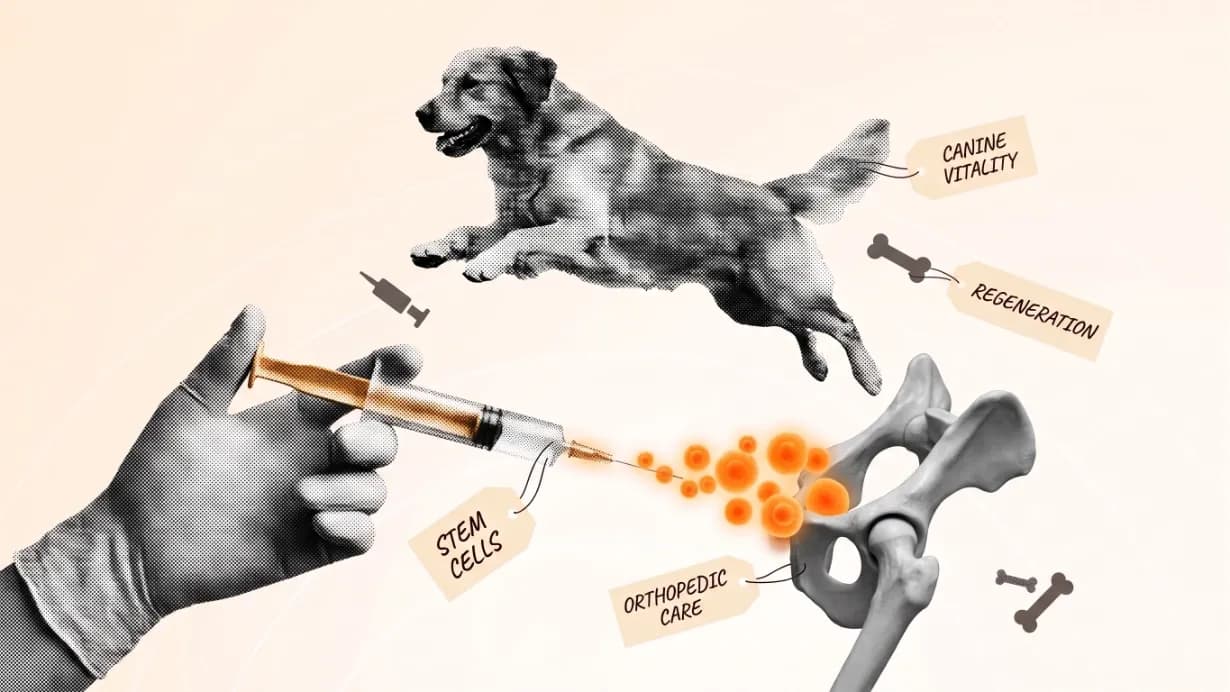

Intra-articular mesenchymal stem cell (MSC) injection has become a standard offer in many companion animal practices for dogs with hip or elbow osteoarthritis, and increasingly for partial cranial cruciate ligament tears. Manufacturer materials promise cartilage repair, durable pain relief, and a credible alternative to lifetime non-steroidal anti-inflammatory drug (NSAID) use, often with retail pricing of $1,500 to $3,000 per joint. Two recent systematic reviews and an independent knowledge summary now describe the foundational evidence as weak, heterogeneous, and largely industry funded. The gap between the brochure and the data is wide enough that it warrants a closer look.
Where This Practice Came From
The companion animal version of stem cell therapy borrowed almost everything from equine tendon work in the early 2000s, where high-value performance horses justified investment in regenerative protocols. Vet-Stem Inc. brought the autologous adipose model into small animal practice in 2003, and the first widely cited canine trial appeared four years later. Black et al. (Veterinary Therapeutics, 2007) ran a randomized, double-blinded, multicenter, placebo-controlled study in 18 dogs with bilateral coxofemoral osteoarthritis. Dogs received either autologous adipose-derived mesenchymal stromal cells intra-articularly or saline, and the treated group showed statistically improved lameness, pain on manipulation, and range of motion scores at day 90. Every author on the paper was a Vet-Stem employee, the product evaluated was the company’s commercial preparation, and every outcome was a subjective orthopedic exam score. By any modern reading, n=18 with industry funding and no objective gait measure is an exploratory trial, not a pivotal one.
A second paper from the same group looked at chronic elbow osteoarthritis in 14 dogs using the same protocol (Black et al., Veterinary Therapeutics, 2008). Findings echoed the hip study. Vilar et al. (BMC Veterinary Research, 2013) then added a force-platform layer to the discussion, treating eight dogs with severe hip osteoarthritis using autologous adipose cells and reporting significant improvement in peak vertical force at one and three months, with the effect attenuating by month six. No control group was included. These three papers, all small, mostly uncontrolled, and either author-funded or industry-funded, became the foundational citation set for almost every subsequent commercial protocol.
The practice spread before regulatory bodies caught up. Vet-Stem, VetCell Therapeutics, Medivet Biologics, and several umbilical-cord tissue bank startups marketed direct-to-veterinarian processing services through continuing-education channels the same companies sponsored. The standard protocol shifted from autologous (requiring fat harvest under general anesthesia and a 48-hour processing turnaround) to allogeneic off-the-shelf cells around 2015. Dosing was never standardized. Published protocols range from 2 million cells per joint up to 50 million cells per joint depending on the manufacturer, with no published dose-response data to anchor the choice. Most commercial dosing recommendations cluster at 5 to 10 million cells per joint, a number that appears to have been set by cell-processing convenience rather than by titration against outcome.
Regulatory positioning has stayed cautious. The European Medicines Agency requires cell-based veterinary medicinal products to follow centralized authorization, and no canine MSC product has yet achieved that authorization. The British Small Animal Veterinary Association classifies stem cell therapy as an emerging technology requiring further validation. The American Veterinary Medical Association continues to refer practitioners to peer-reviewed literature rather than endorse a specific protocol. None of these bodies has revised guidance in the last five years because the underlying evidence base has not meaningfully changed.
What the Current Evidence Shows
The strongest individual trial remains Harman et al. (Frontiers in Veterinary Science, 2016), a prospective, randomized, masked, placebo-controlled study of 74 dogs with hip or elbow osteoarthritis. Dogs received a single intra-articular injection of allogeneic adipose-derived MSCs or saline. Owners scored 79.2% success on the Client-Specific Outcome Measure (CSOM) in the treated group versus 55.4% in placebo (p = 0.029). Veterinary pain on manipulation reached 92.8% success versus 50.2% (p = 0.017), and veterinary global score 86.9% versus 30.8% (p = 0.009). The trial was funded by VetStem Biopharma, the lead author was an employee and shareholder of the funding company, and the primary endpoint was owner-reported. No force-plate or kinetic gait data were collected. It remains the largest placebo-controlled canine MSC trial in the published literature.
Maki et al. (Frontiers in Veterinary Science, 2020) ran a 20-dog double-blinded RCT of allogeneic adipose MSCs in dogs with bilateral hip osteoarthritis, reporting statistically significant reductions in Canine Brief Pain Inventory (CBPI) pain severity and pain interference scores through day 180. The study was funded by VetCell Therapeutics and again relied on owner-reported endpoints. Kim et al. (Frontiers in Veterinary Science, 2019) treated 11 dogs with chronic elbow osteoarthritis using intra-articular umbilical cord MSCs in a placebo-controlled design and found improvement in CBPI scores at eight weeks but no statistically significant change in objective gait analysis.
The most comprehensive synthesis is Olsson et al. (Research in Veterinary Science, 2021), a systematic review of six clinical trials of adipose-derived MSCs in canine hip osteoarthritis: two RCTs and four before-and-after designs. All six studies reported significant improvement in pain and function. The reviewers judged risk of bias as moderate to high in the randomized trials and high in the before-and-after studies. Heterogeneity in cell source, dose, preparation, route, and outcome measures prevented meta-analysis. No included study followed dogs past 12 weeks at most endpoints.
Moloney (Veterinary Evidence, 2022) ran the most rigorous appraisal of the placebo question to date. The PICO asked whether intra-articular allogeneic MSC therapy was more effective than placebo at reducing lameness and pain in dogs with osteoarthritis. Three RCTs met inclusion criteria: Harman 2016, Kim 2019, and Maki 2020. The bottom line was weak evidence for efficacy over placebo, with consistent improvement in client-reported and veterinary subjective scores but no statistically significant change in any objective gait measure across the three trials. The author flagged the conflict-of-interest pattern explicitly: all three included trials had at least one author employed by or financially tied to the cell-supplying company.
For cranial cruciate ligament disease, the data are thinner. Muir et al. (PLoS ONE, 2016) treated 12 dogs with unilateral complete cruciate rupture and contralateral stable partial tear using autologous bone marrow MSCs at 2 million cells/kg intravenously plus 5 million cells intra-articularly. Inflammatory markers (CRP, IFN-gamma) in synovial fluid dropped, but the study was uncontrolled and the primary outcomes were biomarkers rather than clinical or imaging endpoints. Brondeel et al. (Frontiers in Veterinary Science, 2021) reviewed the broader canine osteoarthritis literature and noted that no published trial has demonstrated radiographic, arthroscopic, or histologic evidence of cartilage regeneration in client-owned dogs. Armitage et al. (Frontiers in Veterinary Science, 2023) added a retrospective analysis of 245 dogs treated with autologous MSCs for chronic degenerative musculoskeletal conditions, reporting improvements in stance analysis and owner quality-of-life scores at up to 24 months. The retrospective design and absence of contemporaneous controls limit what conclusions can be drawn.
Safety data are reasonably consistent. Across roughly 400 dogs in published trials, adverse events have been limited to transient joint effusion or mild self-limiting injection-site pain. No tumor formation, ectopic differentiation, or systemic complications have been reported. No major paper in this space has been retracted. Long-term follow-up beyond 12 months remains sparse outside the Armitage retrospective.
The clinically important gap: no published trial directly compares stem cell injection against a standard care arm using carprofen at 2.2 mg/kg PO BID, meloxicam at 0.1 mg/kg PO SID, firocoxib at 5 mg/kg PO SID, or bedinvetmab at 0.5 to 1.0 mg/kg subcutaneously monthly. The question of whether a $1,500 to $3,000 stem cell injection outperforms a $40 bottle of carprofen remains formally untested.
What To Do With This
For a dog with mild to moderate hip or elbow osteoarthritis already managed with weight reduction and an NSAID, a single intra-articular dose of allogeneic adipose-derived MSCs at 5 to 10 million cells per joint is a defensible adjunct, with two caveats stated plainly to the owner. First, the expected effect is analgesic and lasts roughly two to six months in the published literature. Second, no published evidence supports cartilage regeneration; the working mechanism appears to be local immunomodulation through MSC secretome activity rather than structural repair.
First-line treatment for newly diagnosed canine osteoarthritis should remain the protocols with the deepest evidence base: weight reduction to a body condition score of 4 or 5 out of 9, daily EPA plus DHA at approximately 100 mg/kg combined long-chain omega-3, and an NSAID such as carprofen at 2.2 mg/kg PO BID or meloxicam at 0.1 mg/kg PO SID. Bedinvetmab (Librela) at 0.5 to 1.0 mg/kg subcutaneously monthly is reasonable in dogs with NSAID intolerance or concurrent chronic kidney disease. Polysulfated glycosaminoglycan at 2.2 mg/kg intramuscularly twice weekly for four weeks then weekly maintenance has moderate supporting evidence as an adjunct.
Reserve stem cell injection for dogs that have failed multimodal medical management or have absolute contraindications to NSAIDs and bedinvetmab. For partial cranial cruciate ligament tears, the available data do not support routine use outside a research protocol. The 2016 Muir study suggests biological plausibility but not clinical superiority, and no controlled trial has compared MSCs against tibial plateau leveling osteotomy or extracapsular stabilization.
Document baseline and follow-up using objective measures when available. Force-plate or pressure-walkway analysis at baseline and at 4 to 8 weeks post-injection generates exactly the kind of data missing from the published literature, and over time builds a useful internal dataset. Owner-completed CBPI scores at baseline, 4 weeks, and 12 weeks add a validated subjective layer. Be specific in the medical record about consent: document that you discussed the weak evidence grade, the analgesic (not regenerative) expected effect, and the lack of head-to-head comparison against conventional analgesics. During a busy consult, VetEvince provides a fast way to check current evidence grades and dosing ranges for regenerative protocols without leaving the exam room.
The Verdict
The published evidence supports a modest, short-term, subjective benefit of intra-articular allogeneic adipose-derived MSCs over placebo in canine hip and elbow osteoarthritis, with no demonstrated cartilage regeneration and no head-to-head comparison against standard analgesics. A single independent, multi-center, randomized trial of at least 200 dogs comparing MSCs against an active NSAID arm, using force-plate gait analysis as the primary endpoint with 12-month follow-up, would settle the question one way or the other.
Reference Armitage AJ, Miller JM, Sparks TH, Georgiou AE, Reid J. (2023). Efficacy of autologous mesenchymal stromal cell treatment for chronic degenerative musculoskeletal conditions in dogs: a retrospective study. Frontiers in Veterinary Science 9: 1014687. DOI: 10.3389/fvets.2022.1014687 Black LL, Gaynor J, Gahring D, Adams C, Aron D, Harman S, Gingerich DA, Harman R. (2007). Effect of adipose-derived mesenchymal stem and regenerative cells on lameness in dogs with chronic osteoarthritis of the coxofemoral joints: a randomized, double-blinded, multicenter, controlled trial. Veterinary Therapeutics 8(4): 272-284. PMID: 18183546 Black LL, Gaynor J, Adams C, Dhupa S, Sams AE, Taylor R, Harman S, Gingerich DA, Harman R. (2008). Effect of intraarticular injection of autologous adipose-derived mesenchymal stem and regenerative cells on clinical signs of chronic osteoarthritis of the elbow joint in dogs. Veterinary Therapeutics 9(3): 192-200. PMID: 18942020 Brondeel C, Pauwelyn G, de Bakker E, Saunders J, Samoy Y, Spaas JH. (2021). Review: Mesenchymal Stem Cell Therapy in Canine Osteoarthritis Research: “Experientia Docet”. Frontiers in Veterinary Science 8: 668881. DOI: 10.3389/fvets.2021.668881 Harman R, Carlson K, Gaynor J, Gustafson S, Dhupa S, Clement K, Hoelzler M, McCarthy T, Schwartz P, Adams C. (2016). A Prospective, Randomized, Masked, and Placebo-Controlled Efficacy Study of Intraarticular Allogeneic Adipose Stem Cells for the Treatment of Osteoarthritis in Dogs. Frontiers in Veterinary Science 3: 81. DOI: 10.3389/fvets.2016.00081 Kim SE, Pozzi A, Yeh JC, Lopez-Velazquez M, Au Yong JA, Townsend S, Mei N, Lewis DD, Castelhano MG, Todhunter RJ. (2019). Intra-articular Umbilical Cord Derived Mesenchymal Stem Cell Therapy for Chronic Elbow Osteoarthritis in Dogs: A Double-Blinded, Placebo-Controlled Clinical Trial. Frontiers in Veterinary Science 6: 474. DOI: 10.3389/fvets.2019.00474 Maki CB, Beck A, Wallis CB, Choo J, Ramos T, Tong R, Borjesson DL, Izadyar F. (2020). Intra-articular Administration of Allogeneic Adipose Derived MSCs Reduces Pain and Lameness in Dogs With Hip Osteoarthritis: A Double Blinded, Randomized, Placebo Controlled Pilot Study. Frontiers in Veterinary Science 7: 570. DOI: 10.3389/fvets.2020.00570 Moloney M. (2022). In dogs with osteoarthritis, is intra-articular allogenic mesenchymal stem cell therapy more effective than placebo effect? Veterinary Evidence 7(3): 473. DOI: 10.18849/ve.v7i3.473 Muir P, Hans EC, Racette M, Volstad N, Sample SJ, Heaton C, Holzman G, Schaefer SL, Bloom DD, Bleedorn JA, Hao Z, Amene E, Suresh M, Hematti P. (2016). Autologous Bone Marrow-Derived Mesenchymal Stem Cells Modulate Molecular Markers of Inflammation in Dogs with Cruciate Ligament Rupture. PLoS ONE 11(8): e0159095. DOI: 10.1371/journal.pone.0159095 Olsson DC, Teixeira BL, Jeremias TDS, Réus JC, De Luca Canto G, Porporatti AL, Trentin AG. (2021). Administration of mesenchymal stem cells from adipose tissue at the hip joint of dogs with osteoarthritis: A systematic review. Research in Veterinary Science 135: 495-503. DOI: 10.1016/j.rvsc.2020.11.014 Vilar JM, Batista M, Morales M, Santana A, Cuervo B, Rubio M, Cugat R, Sopena J, Carrillo JM. (2013). Assessment of the effect of intraarticular injection of autologous adipose-derived mesenchymal stem cells in osteoarthritic dogs using a double blinded force platform analysis. BMC Veterinary Research 9: 131. DOI: 10.1186/1746-6148-9-131