
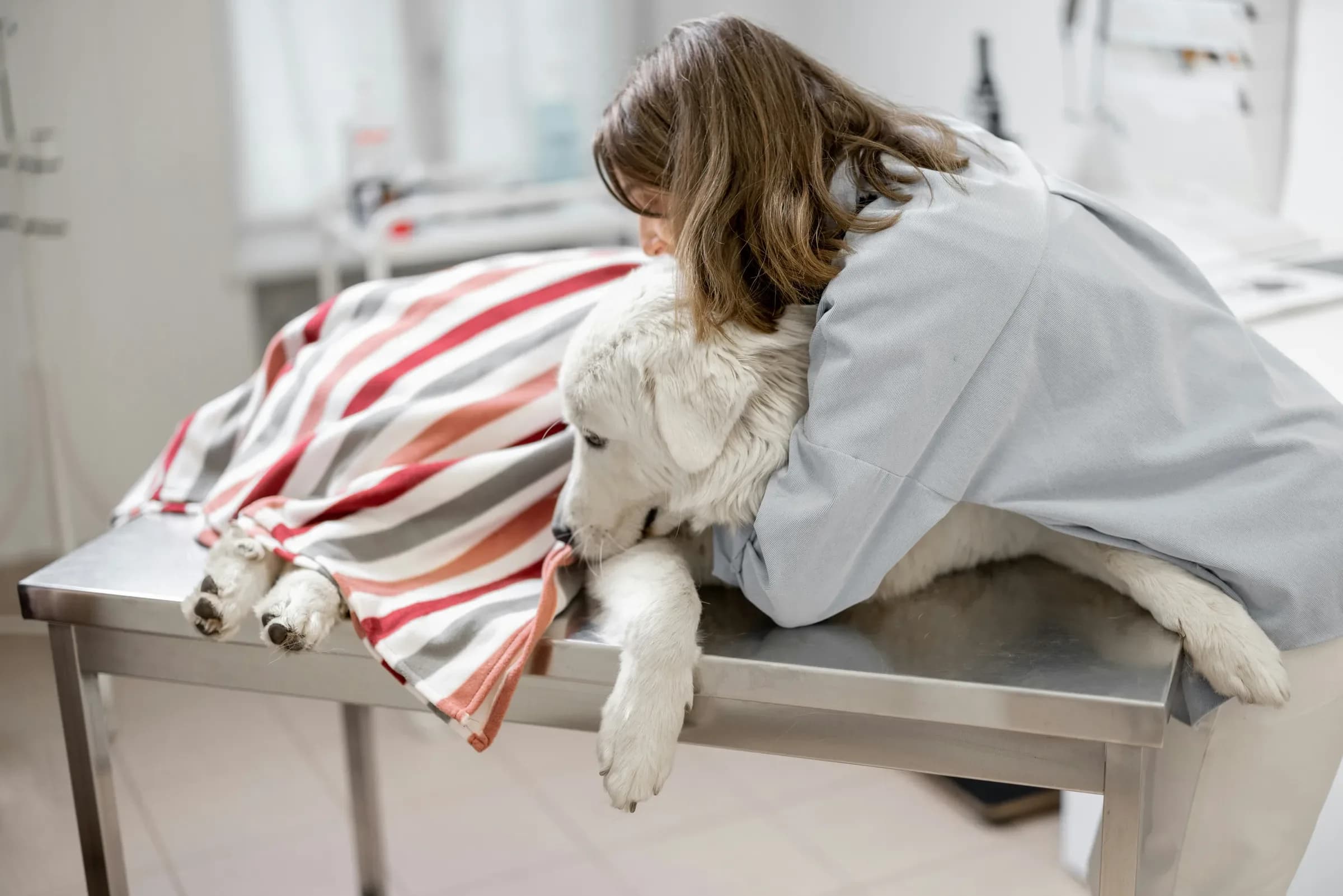

Most of the attention in a veterinary anesthetic goes to induction and the procedure itself. That is where the drugs are drawn up, the tube goes in, and the team is gathered around the table. The best data we have says the patient is most likely to die later, after the procedure is over and the team has moved on to the next case.
How risky is anesthesia for a dog?
For a healthy dog, the risk of anesthetic-related death is roughly 1 in 2,000. For a sick dog it is more than twenty times higher, at about 1 in 75. Those figures come from the Confidential Enquiry into Perioperative Small Animal Fatalities (CEPSAF), a prospective cohort of 98,036 dogs and 79,178 cats anesthetized or sedated in 117 UK centers between June 2002 and June 2004 (Brodbelt et al., Veterinary Anaesthesia and Analgesia, 2008).
The overall risk of anesthetic- and sedation-related death within 48 hours was 0.17% in dogs (1 in 601) and 0.24% in cats (1 in 419). The split by health status is where the numbers become clinically useful.
| Group | Risk of anesthetic-related death | Roughly | 95% CI |
|---|---|---|---|
| Healthy dogs (ASA 1 to 2) | 0.05% | 1 in 1,849 | 0.04 to 0.07% |
| Sick dogs (ASA 3 to 5) | 1.33% | 1 in 75 | 1.07 to 1.60% |
| Healthy cats (ASA 1 to 2) | 0.11% | 1 in 895 | 0.09 to 0.14% |
| Sick cats (ASA 3 to 5) | 1.40% | 1 in 71 | 1.12 to 1.68% |
Source: Brodbelt et al., Veterinary Anaesthesia and Analgesia 2008;35:365 to 373 (CEPSAF), deaths within 48 hours.
A newer UK study using primary care records from VetCompass puts the overall figure for dogs slightly lower. Across 157,318 dogs anesthetized or sedated between 2010 and 2013, 0.10% died of anesthetic or sedation-related causes within 48 hours and 0.14% within two weeks (Shoop-Worrall et al., Veterinary Anaesthesia and Analgesia, 2022). Among 89,852 dogs having a neuter, the figure was 0.009%. Greater age, poorer ASA status and more urgent procedures were all associated with higher odds of death.
So for a young healthy dog having an elective procedure, anesthetic death is rare. For an old, sick dog on an emergency list, it is not rare at all, and that difference should be visible in how a practice staffs and watches the case.
When the deaths happen
CEPSAF is still the best source on timing, because it recorded when each death occurred. In dogs, 47% of anesthetic-related deaths happened in the postoperative period. In cats the figure was 61%. Most postoperative deaths occurred within three hours of the end of the procedure.
CEPSAF is still the best source on timing, because it recorded when each death occurred. In dogs, 47% of anesthetic-related deaths happened in the postoperative period.
Source: CEPSAF, Brodbelt et al. 2008, Table 5. Premed = after premedication; Maint. = maintenance; the last five bars are hours after the procedure ended (postoperative deaths total 70, of which 31 occurred in the first three hours).
Source: CEPSAF, Brodbelt et al. 2008, Table 5.
Source: CEPSAF, Brodbelt et al. 2008.
Maintenance still matters, and in dogs it accounted for almost as many deaths as the whole postoperative period. What stands out is induction. It is the phase teams brace for and it produced the fewest deaths of the three main phases. The review panel classified most deaths in dogs and cats as primarily cardiovascular or respiratory, 74% and 72% respectively.
Why recovery is where patients are lost
The data does not explain the pattern, but anyone who has worked a busy surgical list can guess at it. During the procedure a patient has a person assigned to it, equipment attached to it and the team's attention. In recovery, the tube comes out, the monitoring leads come off, and the person who was watching often goes to set up the next case. The patient is still hypothermic, still clearing drugs, and now responsible for its own airway.
Cats make the point more strongly. Nearly two thirds of feline anesthetic deaths in CEPSAF were postoperative. Small size, a tendency to hypothermia and the stress of recovery all plausibly contribute, and all of them are easy to underestimate once a cat looks awake.
I should be careful about the age of this evidence. CEPSAF was collected more than twenty years ago, drugs and monitoring have improved since, and the 2022 VetCompass figures suggest overall risk has come down. What neither study suggests is that recovery has become safe enough to ignore. Deaths still cluster where attention drops.
What practices can change
Staff recovery like a phase of anesthesia, because it is one. Someone should own each patient until it is extubated, normothermic, maintaining its airway and responsive. For higher-ASA patients, that person should not also be setting up the next procedure.
Keep monitoring into recovery for sick patients. Pulse oximetry, temperature and respiratory rate cost little to continue for the first hours after a procedure, which is exactly the window the CEPSAF timing data points to.
Treat hypothermia as a risk, not a nuisance. Hypothermia has been identified as a risk factor for anesthetic-related death in later case-control work, and it is common after long procedures, especially in small patients and cats.
Record vitals the same way in recovery as on the table. A recovery chart that exists only as "recovered well" gives the next person nothing to compare against when a patient deteriorates.
Match the list to the risk. An ASA 4 patient at the end of a long day, when the team is tired and short-handed, is carrying risk the numbers above describe very clearly.
Where clinical support fits
Most anesthetic records are written by a technician doing three things at once. A reading that should raise a question can pass without one, not because anyone missed it, but because nobody had a moment to compare it against that patient's breed, age, conditions and drugs.
That is the gap AI Anesthesia Assist is built for. At each vitals entry, it reads the numbers against the patient's full history and returns an advisory stability or risk indication with a guideline-based comment, usually in 10 to 30 seconds. Vitals are entered manually today. viggoVet's AI is clinical decision-support only: it assists, it does not decide, and the licensed veterinarian holds full clinical responsibility. It is not a medical device, monitor, or alarm.
The evidence above suggests the question to ask of any tool or protocol is simple: does it still have your attention three hours after the procedure ends?
References
- Brodbelt DC, et al (2008). The risk of death: the Confidential Enquiry into Perioperative Small Animal Fatalities. Veterinary Anaesthesia and AnalgesiaLink
- Shoop-Worrall SJ, O'Neill DG, Viscasillas J, Brodbelt DC (2022). Mortality related to general anaesthesia and sedation in dogs under UK primary veterinary care. Veterinary Anaesthesia and Analgesia
- Matthews NS et al (2017). Factors associated with anesthetic-related death in dogs and cats in primary care veterinary hospitals. JAVMALink