
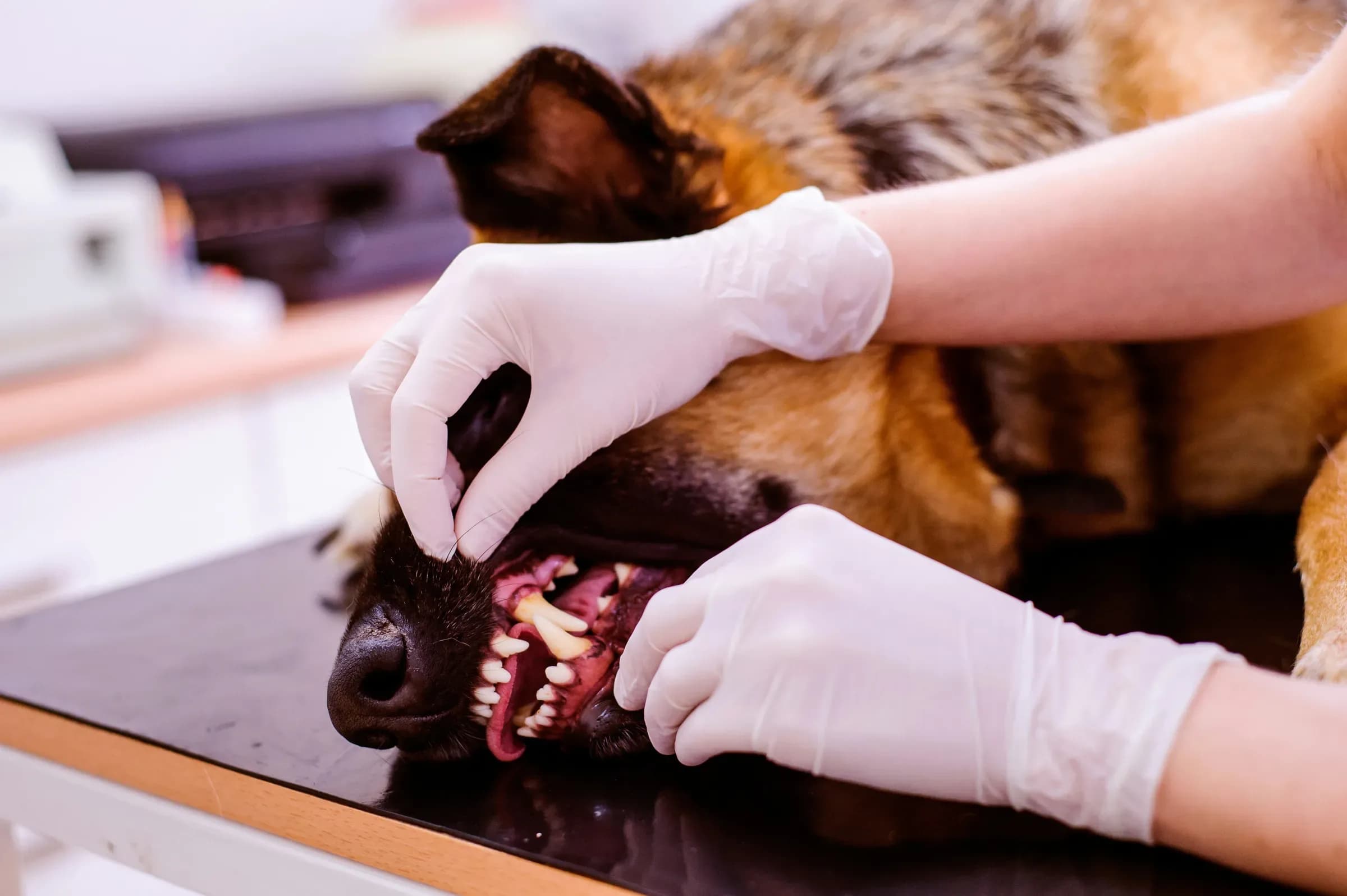

Periodontal disease was the single most commonly diagnosed disorder in dogs under primary veterinary care in the UK, recorded in 12.5% of dogs over one year (O'Neill et al., Journal of Small Animal Practice, 2021). In cats, the one-year figure was 15.2% (O'Neill et al., Journal of Feline Medicine and Surgery, 2023).
Those numbers come from large samples of real clinical records, and they are almost certainly too low. The same authors point out that prospective studies examining dogs under anesthesia have reported prevalence as high as 63%. The gap between what gets recorded and what is in the mouth is the most useful thing a general practitioner can take from this literature.
What are the stages of periodontal disease in dogs and cats?
The American Veterinary Dental College classifies periodontal disease from PD0 to PD4 by how much of the tooth's attachment has been lost, measured by probing or on dental radiographs.
| Stage | Name | Attachment loss | Furcation involvement (multirooted teeth) |
|---|---|---|---|
| PD0 | Clinically normal | None | None |
| PD1 | Gingivitis only | None; alveolar margin height and architecture normal | None |
| PD2 | Early periodontitis | Less than 25% | At most stage 1 |
| PD3 | Moderate periodontitis | 25% to 50% | Stage 2 |
| PD4 | Advanced periodontitis | More than 50% | Stage 3 |
Source: AVDC nomenclature, as summarized in the Ohio State University CVM clinical skills handbook.
The practical point is in the middle column. Stages 2 to 4 are defined by attachment loss, which you cannot see on a conscious patient. You find it with a periodontal probe and dental radiographs, and both need anesthesia. A mouth that looks like "mild tartar" on a consult table can hold a PD3 or PD4 tooth that the exam could not detect.
The practical point is in the middle column. Stages 2 to 4 are defined by attachment loss, which you cannot see on a conscious patient.
Which dogs and cats are most at risk
The VetCompass dog study, covering 22,333 dogs attending 784 UK clinics in 2016, found risk rose steadily with age. Compared with dogs aged two to four, the adjusted odds of a periodontal disease diagnosis were 1.91 at four to six years and 3.91 in dogs over twelve.
The VetCompass dog study, covering 22,333 dogs attending 784 UK clinics in 2016, found risk rose steadily with age. Compared with dogs aged two to four, the adjusted odds of a periodontal disease diagnosis were 1.91 at four to six years and 3.91 in dogs over twelve.
Source: O'Neill et al., J Small Anim Pract 2021. Reference group: dogs aged 2 to 4 years (odds ratio 1).
Size mattered as much as age. Dogs under 10 kg had more than three times the adjusted odds of dogs weighing 30 to 40 kg. Among breeds, the highest adjusted odds were in the Toy Poodle (3.97), King Charles Spaniel (2.63), Greyhound (2.58) and Cavalier King Charles Spaniel (2.39), each compared with crossbreeds.
In cats, the VetCompass study of 18,249 cats seen in 2019 found cats over nine had more than six times the odds of cats under three. Siamese and Maine Coon cats had the highest breed prevalence, at 18.7% and 16.7%. Cats with periodontal disease also had 1.79 times the odds of having at least one other disorder diagnosed.
Why the record undercounts
Primary care prevalence depends on someone looking, recognizing and recording. Periodontal disease is chronic, painful in a way animals hide well, and easy to mention in a consultation without ever becoming a coded diagnosis. The VetCompass authors say plainly that "many true cases of periodontal disease may be missed in the primary care setting."
For a practice, undercounting matters in two ways. Clinically, a disease that is not recorded is not tracked, so a PD2 tooth drifts to PD4 across three annual visits without anyone noticing the trend. Commercially and ethically, the gap between the one dog in eight a practice records and the much larger share that likely has disease is care that owners are never offered.
Charting that changes what happens next
Staging only helps if it is recorded tooth by tooth, in a way the next clinician can compare against. Three habits make the biggest difference.
Stage every tooth, every time. A whole-mouth grade such as "grade 2 dental" hides the one tooth that needs extraction. The AVDC scheme is per tooth for a reason.
Record the stage alongside the procedure. "Scale and polish, extracted 108" tells the next vet what was done. "108 PD4, 208 PD3, remainder PD1" tells them what is happening in the mouth.
Explain the stage to the owner in writing. Owners understand "stage 3 of 4, with half the bone support gone" far better than "moderate periodontitis," and a written explanation is something they can read again at home before deciding on treatment.
That last habit is why we built AI Dental Chart to generate a plain-language letter for the owner from the same chart the clinician fills in. You mark each tooth and its condition, and the record, the prognosis and the owner's explanation all come from one charting session. The veterinarian reviews and signs off everything before it leaves the practice.
The short version
Periodontal disease is the most common diagnosis in general practice and still undercounted, because the stages that matter most can only be seen under anesthesia. Probe and radiograph, stage every tooth, and write it down in words the owner can follow.
References
- O'Neill DG, Mitchell CE, Humphrey J, Church DB, Brodbelt DC, Pegram C (2021). Epidemiology of periodontal disease in dogs in the UK primary-care veterinary setting. J Small Anim PractLink
- O'Neill DG, Blenkarn A, Brodbelt DC, et al (2023). Periodontal disease in cats under primary veterinary care in the UK: frequency and risk factors. J Feline Med SurgLink
- AVDC periodontal disease stages, as summarized in the OSU CVM Veterinary Clinical and Professional Skills Center Handbook:Link