For 15 years, my “enemy” in the exam room was Dr. Google. Owners would come in armed with printouts from forums, convinced they knew more than I did. But today, the enemy has evolved. It is smarter, faster, and significantly more dangerous. It is Dr. ChatGPT.
And the terrifying part? It isn’t just pet owners using it. It’s us.
Veterinarians are currently drowning in a data crisis. Medical knowledge now doubles every 73 days. . To keep up, overwhelmed vets are turning to Large Language Models (LLMs) like ChatGPT and Gemini to write SOAP notes, calculate dosages, and triage cases.
The problem is that these “generalist” models operate like the cartoon character “Baba Big.” They change hats instantly, one second they are a plumber, the next a poet, the next a surgeon. They are trained on the open internet, which means they learn veterinary medicine from the same “garbage” dataset where someone describes hugging their dog to cure depression.
When a general AI hallucinates in a poem, it’s funny. When it hallucinates a drug interaction for a horse during anesthesia, it is malpractice.
The Great Divide: Human vs. Veterinary Tech If you look at human healthcare, the doors are closing. By the end of 2025, it is estimated that 40% of human physicians will use evidence-based AI tools built specifically for them, walled gardens of data that the general public cannot access. Corporations like Microsoft and Google are building “Med-PaLM” and radiology AI specifically for human biology.
Meanwhile, the veterinary industry is being left to scavenge. We are expected to use the same “public” tools as our clients. This creates a crisis of authority: If a client has the same access to the same AI as I do, what is the value of my license?
The “Angry Vet” Solution I launched VetEvince not as a tech entrepreneur, but as an angry veterinarian. I was tired of seeing my colleagues rely on assumptions rather than evidence.
We realized that to fix this, we couldn’t just “wrapper” ChatGPT. We had to build a new brain. We sent a call out to the global veterinary community, and the response was overwhelming. Over 300 veterinarians contributed their private archives, lecture notes, student guides, clinical papers – resulting in a dataset of over 5 million copyright-free, verified veterinary documents.
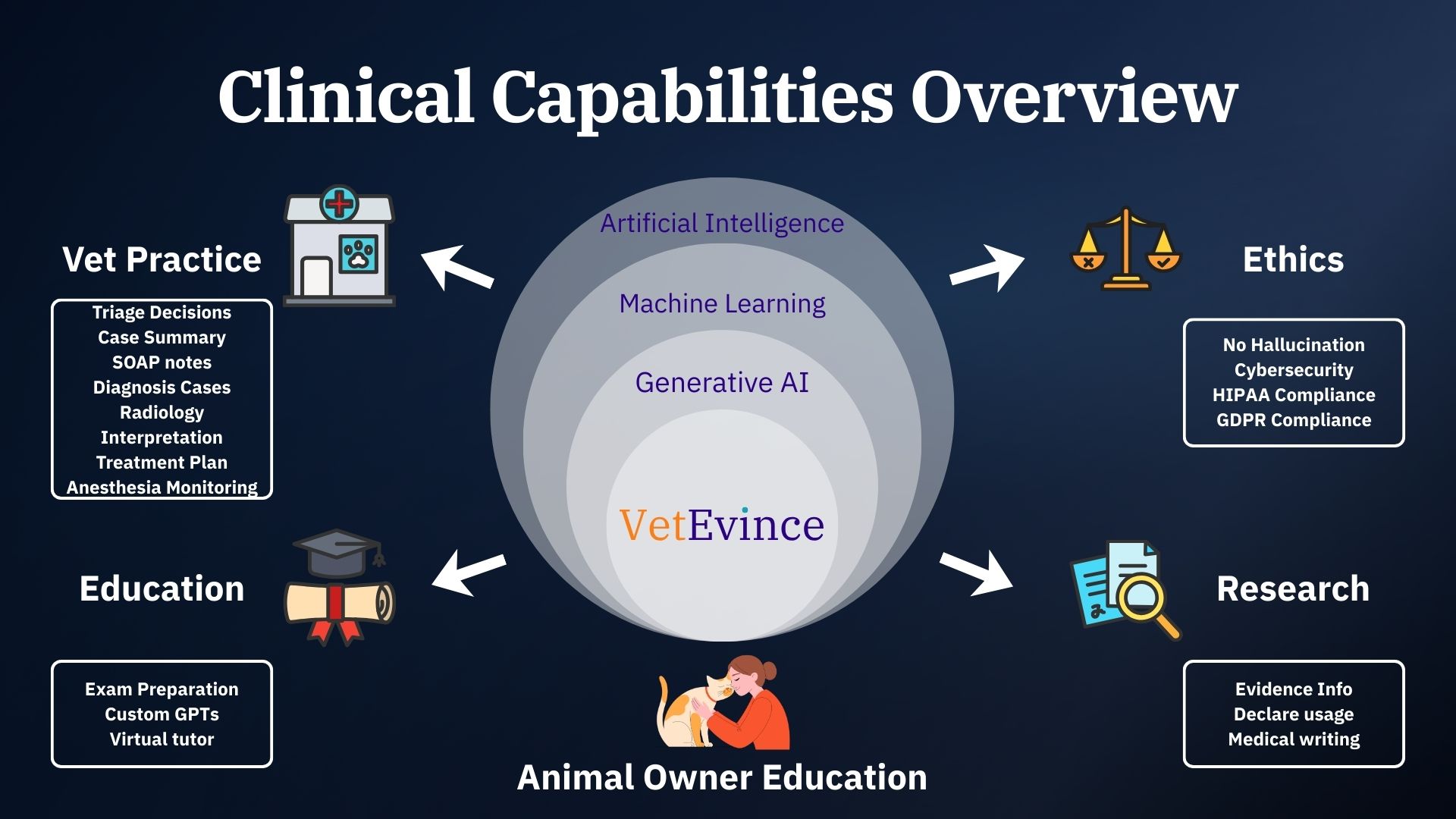
We categorized this data into over 900 specific domains. Why? Because a Golden Retriever is not a human, and an equine heart is not a feline heart.
The End of the “Black Box” The result is an AI that operates on a “closed-loop” system.
- No Hallucinations: It does not predict the next word; it retrieves a verified fact.
- Citations: Every claim comes with a link to the source material (textbook, journal, guideline).
- Liability Shift: When you use a general AI, you are liable for its guesses. When you use an evidence-based tool, the liability rests on the source quality.
We Are Not Second-Class Science In human medicine, one mistake hurts one patient. In veterinary production medicine, one mistake in a farm protocol can compromise the food supply for thousands. The stakes are arguably higher, yet our tools are weaker.
We are releasing VetEvince for free to the veterinary community (funded by our Practice Management Software) because this shouldn’t be a luxury. It should be the standard. We need to stop accepting the “scraps” of the tech world.
It is time we stop asking a chatbot trained on Reddit to calculate anesthesia protocols. Our patients – and our profession – deserve an AI that actually went to vet school.