

Serious psychological distress afflicts veterinary practice team members at rates three times higher than the general employed population, according to findings from the 2023 Merck Animal Health Veterinary Team Study published in the Journal of the American Veterinary Medical Association. The research, which surveyed 2,271 nonveterinarian practice employees across the United States, documented prevalence rates of psychological distress at 20 percent among veterinary technicians, assistants, practice managers, and client service representatives, compared to 6.3 percent among employed, college-educated US adults.
The study represents the most comprehensive assessment to date of burnout, well-being, and mental health among nonveterinarian members of veterinary practice teams. Conducted between September 11 and October 9, 2023, the research employed validated instruments including the Burnout Assessment Tool, Kessler Psychological Distress Scale, and Cantril Ladder well-being index to enable direct comparison with both veterinarian populations and general workforce data.
Research methodology included recruitment through the North American Veterinary Technicians Association, Veterinary Hospital Managers Association, a large multi-site hospital group, and referrals from veterinarians participating in a companion survey. The protocol received exemption from the Advarra Institutional Review Board. Respondents were predominantly female (79 percent) and under age 45 (81 percent), with the majority holding college degrees (62 percent) and working in companion animal practices (86 percent).
Burnout and Exhaustion Among Practice Teams
Analysis using the Burnout Assessment Tool revealed that 27 percent of practice team members experienced high to very high levels of burnout, with significant variation by role. Veterinary technicians demonstrated the highest rates, with 31 percent reporting high or very high burnout, compared to 22 percent of client service representatives and 21 percent of practice managers. These figures approach those documented among veterinarians, though the component analysis revealed distinct patterns.
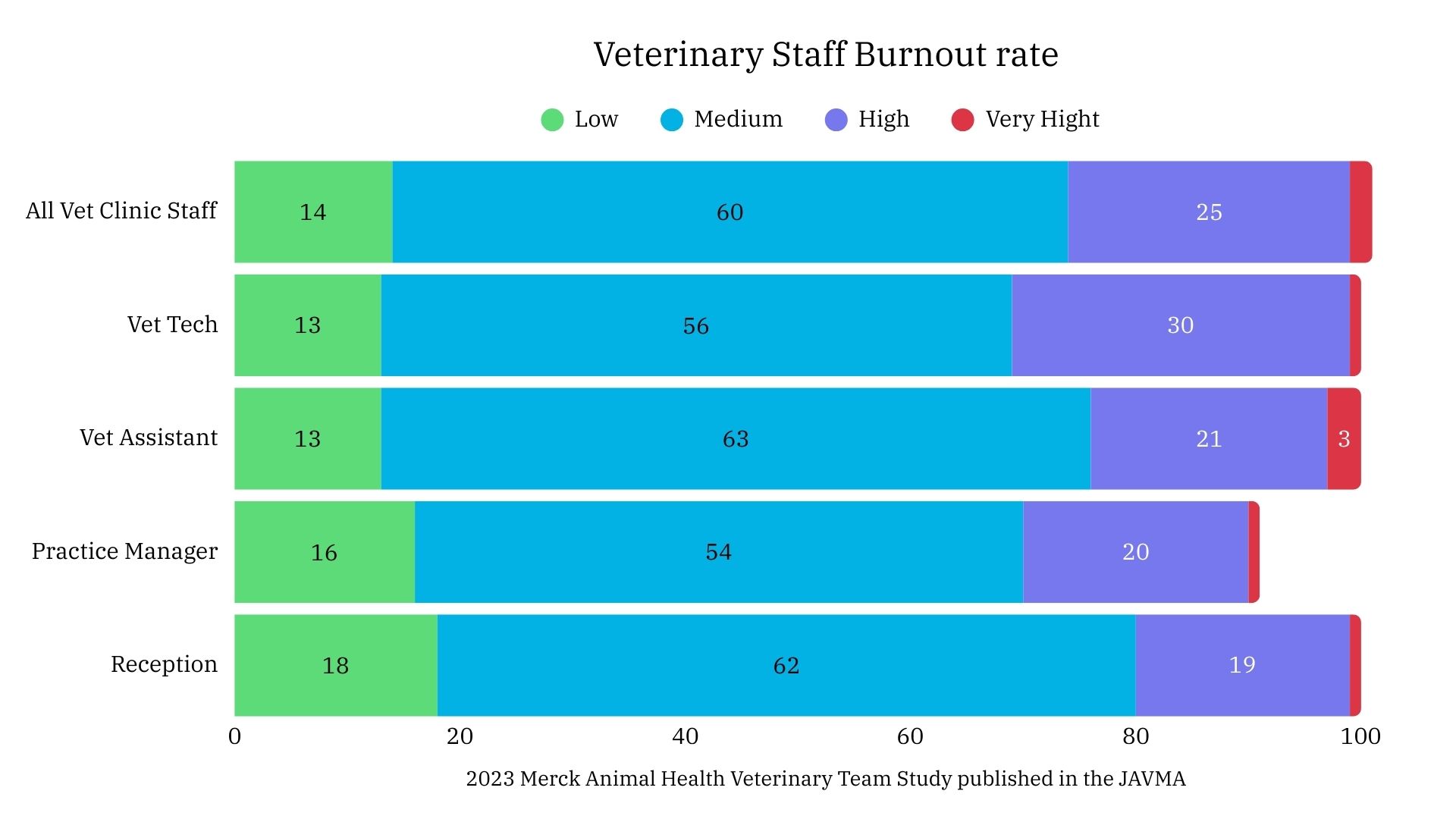
The exhaustion component of burnout proved particularly severe among practice team members. Seventy-one percent scored high or very high in exhaustion, substantially exceeding rates observed in general workforce studies. In contrast, cognitive impairment (24 percent), emotional impairment (22 percent), and mental distance (34 percent) occurred at lower frequencies. This pattern suggests that physical and emotional depletion, rather than detachment or impaired functioning, constitutes the primary manifestation of burnout in veterinary support roles.
Multiple regression analysis identified working more than 45 hours per week and/or nights and weekends as a significant predictor of burnout (b = 0.12). Additional factors associated with elevated burnout included working in a negative clinic culture (b = 0.07) and carrying student debt (b = 0.02). Personality characteristics, particularly neuroticism, emerged as the strongest predictor of burnout (b = 0.20), consistent with established psychological research on stress vulnerability.
Protective factors against burnout included experiencing good work-life balance (b = -0.10), satisfaction with position and advancement opportunities (b = -0.07), working in a positive clinic culture (b = -0.07), and possessing effective stress coping mechanisms (b = -0.05). All associations reached statistical significance at the P < .01 level. The identification of these modifiable factors suggests potential intervention targets at both organizational and individual levels.
Well-Being Deficits in Veterinary Practice Teams
Assessment using the Cantril Ladder revealed substantial deficits in well-being among practice team members compared to both veterinarians and the general population. Only 42 percent of respondents met criteria for flourishing (scores of 7 to 10 on a 10-point scale), with 52 percent categorized as getting by (scores of 4 to 6) and 7 percent suffering (scores of 0 to 3). Practice managers reported the highest rates of flourishing (52 percent), while veterinary assistants reported the lowest (34 percent).
These findings contrast sharply with well-being data from the general employed population, where flourishing rates typically exceed 50 percent according to Gallup World Poll data. The concentration of practice team members in the “getting by” category suggests widespread experience of moderate life dissatisfaction rather than acute crisis, though the 7 percent suffering rate represents a concerning subpopulation at substantial risk.
Working in a positive clinic culture emerged as the strongest predictor of high well-being (b = 0.11), followed by engaging in healthy activities outside work (b = 0.10), satisfaction with one’s position (b = 0.09), and effective stress coping mechanisms (b = 0.09). Conversely, working extended hours or irregular schedules strongly predicted low well-being (b = -0.16), as did personality characteristics high in neuroticism (b = -0.09). The magnitude of these associations suggests that organizational factors exert substantial influence on team member well-being, independent of individual personality traits.
Financial Stress as Contributing Factor
The research documented substantial financial stress among veterinary practice team members, with multiple indicators suggesting economic strain may contribute to observed mental health outcomes. When asked to rate 14 issues facing the veterinary profession, 68 percent of respondents identified poor compensation of practice employees as critically important, with an additional 20 percent rating it moderately important. This represented the highest-rated concern among all issues presented.
Objective financial indicators corroborated subjective reports of economic stress. Fifty-eight percent of respondents carried credit card debt that they did not pay off monthly, while 48 percent reported student loan obligations. Mean hourly wages ranged from $21 to $26 for client service representatives, veterinary assistants, and veterinary technicians, with practice managers earning approximately $30 per hour. One in four practice team members worked a second job outside veterinary medicine, suggesting that primary employment income proved insufficient to meet financial needs.
Only 42 percent of respondents reported satisfaction with their income or financial situation, despite 75 percent expressing satisfaction with their veterinary work itself. This discrepancy indicates that financial dissatisfaction exists independent of job content satisfaction. Higher income demonstrated modest positive associations with well-being (b = 0.05) and mental health (b = -0.05), while debt burden predicted serious psychological distress (b = 0.02), though these effects were smaller than those of organizational and personality factors.
Personality and Vulnerability to Distress
Assessment using the Big Five personality inventory revealed that practice team members scored higher on average in neuroticism compared to both veterinarians and the general employed population. Neuroticism, characterized by tendency toward anxiety and negative emotional responses, functioned as the predominant predictor of serious psychological distress (b = 0.31), substantially exceeding the predictive power of any work-related or demographic variable. This finding aligns with established psychological research demonstrating that individuals high in neuroticism experience greater reactivity to environmental stressors.
The elevated neuroticism scores among veterinary practice teams suggest potential self-selection into caregiving roles or, alternatively, that chronic exposure to occupational stressors may amplify neurotic tendencies over time. Longitudinal research would be required to distinguish these possibilities. Regardless of causal direction, the strong association between neuroticism and mental health outcomes indicates that personality assessment could inform targeted intervention strategies.
Practice team members also scored higher than the general population in extroversion, which may prove advantageous in client-facing roles. However, extroversion did not demonstrate significant associations with mental health outcomes in regression analysis, suggesting that while it may facilitate certain job functions, it does not buffer against psychological distress in the manner that low neuroticism does.
Organizational Culture and Team Functioning
Clinic culture characteristics demonstrated substantial associations with multiple outcomes. The study operationalized positive clinic culture through four dimensions: strong sense of team belonging, candid and open communication among team members, high degree of organizational trust, and sufficient time for quality patient care. Fewer than 25 percent of veterinary technicians, veterinary assistants, and client service representatives reported that these characteristics described their practices to a great extent, with 66 to 71 percent indicating these terms described their workplaces only “a little” or “somewhat.”
Practice managers rated their clinic cultures significantly more favorably than other team members, suggesting potential divergence in perception between management and staff. This perception gap may itself constitute a cultural problem, as accurate assessment of workplace conditions requires alignment between leadership understanding and staff experience. The substantial associations between positive clinic culture and outcomes (b = 0.11 for well-being, b = -0.07 for burnout) suggest that organizational interventions targeting these cultural dimensions could yield meaningful improvements.
Additional organizational factors associated with outcomes included availability of career advancement opportunities, utilization of team members according to their training and capabilities, and provision of Employee Assistance Programs. Research by Fanning and Shepherd documented that gross revenue per veterinarian increased by approximately $90,000 for each additional veterinary technician employed, suggesting that optimal utilization of credentialed team members benefits both staff satisfaction and practice economics.
Coping Strategies and Work-Life Integration
Possession of effective stress coping mechanisms proved protective against serious psychological distress (b = -0.12), low well-being, and burnout. However, only 30 percent of respondents strongly agreed that they had effective mechanisms for dealing with stress, with an additional 36 percent reporting slight agreement. When asked about specific coping methods, the most commonly reported strategy was distraction through television or computer games, which mental health professionals on the research team classified as non-productive coping.
More adaptive coping behaviors included spending time with family (78 percent), socializing with friends (66 percent), engaging in hobbies (62 percent), outdoor activities (62 percent), and reading for pleasure (60 percent). These activities demonstrated positive associations with reduced burnout and improved well-being. The frequent engagement in family and social activities aligns with psychological research demonstrating that social connection constitutes a fundamental component of mental health and resilience.
Work-life balance emerged as the leading predictor of low burnout and contributed significantly to well-being and mental health. Despite recognition of its importance, achievement of work-life balance appeared elusive for many respondents, particularly given that extended work hours and irregular schedules (nights and weekends) demonstrated strong negative associations with all measured outcomes. This suggests that structural features of veterinary practice schedules may fundamentally conflict with work-life balance, requiring systemic rather than individual solutions.
Implications for Veterinary Practice Management
The research findings indicate multiple leverage points for intervention at the organizational level. Practice managers can address burnout and mental health through modifications to scheduling practices, specifically by limiting extended work hours and irregular shifts where operationally feasible. Implementation of such changes may require practice restructuring, including increased staffing levels or redistribution of emergency coverage responsibilities across larger networks.
Development of positive clinic culture represents another actionable target. The study identified specific cultural dimensions—team cohesion, open communication, organizational trust, and adequate time for quality care—that demonstrate measurable associations with staff outcomes. Practice managers can assess current culture through anonymous staff surveys, establish improvement goals collaboratively with teams, and implement regular monitoring to track progress. Only 37 percent of respondents reported that mental health was openly discussed in team meetings, suggesting that destigmatization efforts through regular discussion could prove beneficial.
Compensation remains a challenge that individual practices may find difficult to address given economic constraints. However, the study suggests that job satisfaction and meaning-finding in work remain high despite compensation dissatisfaction, indicating that improvements in non-financial domains could offset some effects of economic stress. Practices might consider providing access to financial planning resources or establishing partnerships with financial advisors who can offer budgeting support and debt management guidance to staff.
Study Limitations and Future Research
The research methodology presents several limitations that warrant consideration. Recruitment through professional associations and a large hospital group rather than random sampling prevents assessment of sample representativeness. Response bias may have favored individuals experiencing greater distress, potentially inflating prevalence estimates. The cross-sectional design precludes causal inference, limiting conclusions about whether identified factors actively influence outcomes or merely correlate with them.
The study compared practice team members to general population norms rather than to comparable occupational groups with similar educational levels and job characteristics. Such comparisons would provide better context for interpreting whether observed rates of distress exceed what would be expected given job demands. Additionally, the research did not assess whether mental health problems predated veterinary employment or developed subsequently, information relevant to distinguishing occupational causation from self-selection.
Future research should employ longitudinal designs to track mental health trajectories over time and evaluate whether workplace interventions produce measurable improvements. Investigation of practices that maintain high staff well-being despite challenging conditions could identify protective organizational structures and practices. Finally, economic analysis of the costs of poor mental health through turnover, absenteeism, and reduced productivity could strengthen the business case for investment in staff well-being initiatives.
Conclusions
This comprehensive assessment documented serious mental health concerns among veterinary practice team members, with rates of psychological distress, burnout, and low well-being substantially exceeding those observed in the general employed population. The research identified both individual factors, particularly personality characteristics and coping strategies, and organizational factors, including clinic culture, scheduling practices, and opportunities for advancement, as significant correlates of mental health outcomes. Financial stress emerged as a notable concern, though its effects on mental health were smaller than those of organizational and personality variables.
The findings suggest that interventions targeting organizational factors may prove most effective, given that practices can more readily modify workplace culture, schedules, and advancement opportunities than they can address individual personality characteristics or economic conditions. Implementation of Employee Assistance Programs, regular mental health discussions to reduce stigma, and systematic efforts to improve clinic culture through enhanced team cohesion, communication, and trust represent actionable strategies supported by the research findings.
Veterinary practice team members demonstrate strong commitment to their work and derive meaning from contributions to animal welfare and client service. However, the documented prevalence of serious psychological distress and burnout indicates that systemic problems in veterinary workplace conditions require attention. Addressing these concerns serves not only humanitarian aims but also practice sustainability, as poor staff mental health inevitably affects retention, performance, and quality of care delivery.